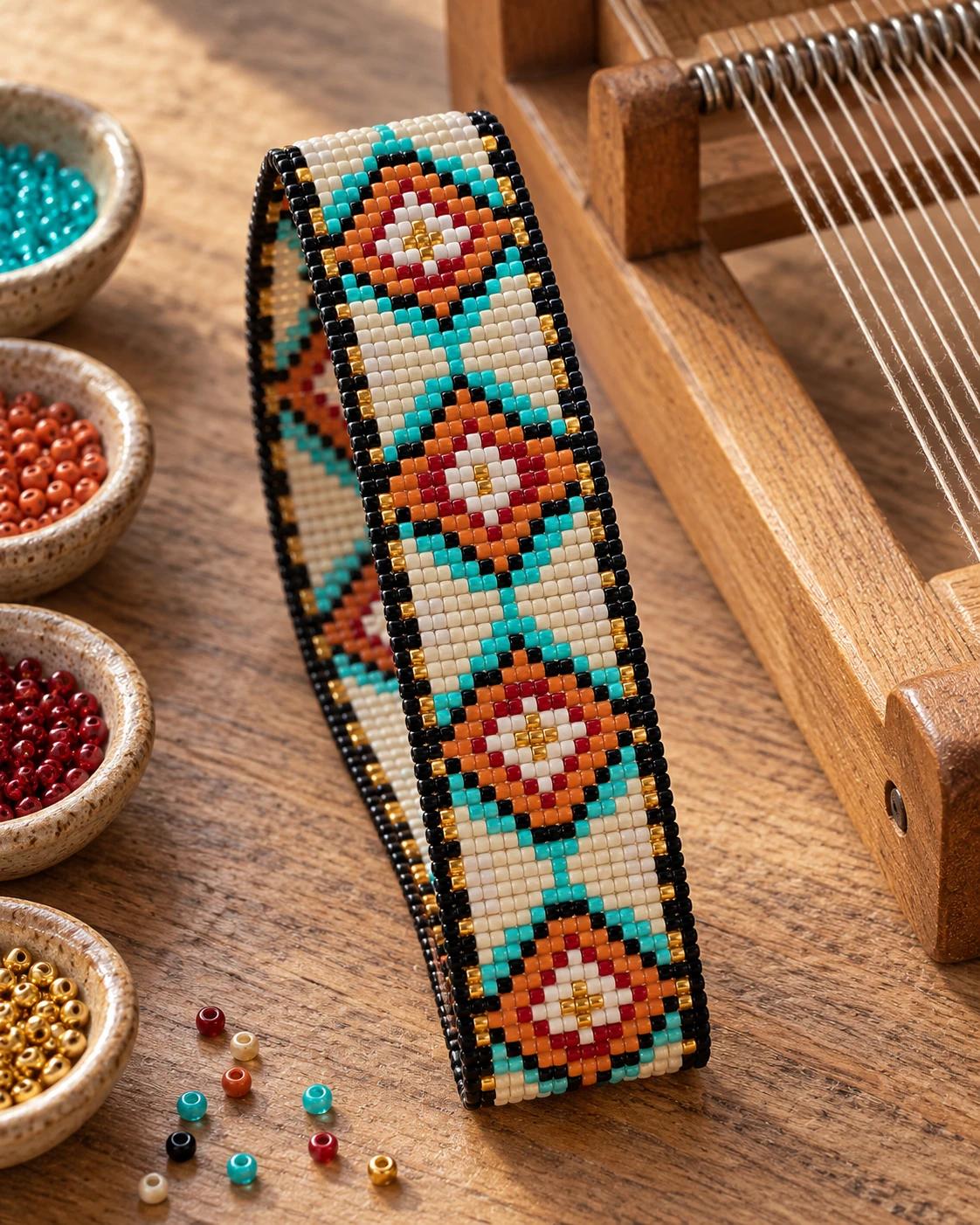
Short answer
A beaded bracelet pattern is a chart of the band, one cell per bead, with a colour key and the size it was drawn for. To fit your wrist, add 1.5 cm for a comfortable fit, subtract the clasp and divide by the row length: a 16 cm wrist takes 70 rows of Preciosa 10/0 on a loom.
What you need
- Your wrist measurement in cm, taken with a soft tape or a strip of paper
- Seed beads in 3 to 5 colours: Preciosa 10/0 or Miyuki Delica 11/0 for a first bracelet
- A bead loom for loom weaving, or only a needle for square stitch, peyote and brick stitch
- Strong beading thread and a beading needle
- A clasp: slide clasp, end bars, a button or a magnetic clasp
Words the chart uses
- Beaded band
- The woven part of the bracelet, without the clasp. The chart has to fill exactly this length.
- Ease
- The length added to the wrist so the bracelet can move: 1 cm snug, 1.5 cm comfortable, 2.5 cm loose.
- Beads across
- How many beads make one row of the band. It sets the width and how much detail fits.
- Repeat
- The part of the design that appears again down the band, counted in rows, including the gap after it.
- Warp
- The lengthwise threads on a loom. You need one more than the beads across: 13 for a 12-bead band.
What a beaded bracelet pattern shows
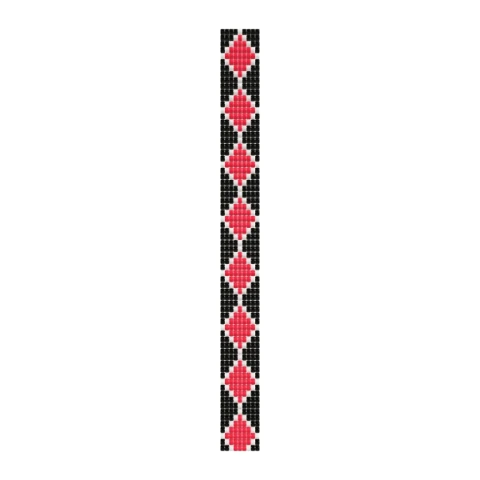
A beaded bracelet pattern is a chart of the band: one cell per bead, each cell a colour or a letter that points to the key. A complete pattern also names the technique, the bead brand and size, the beads across and the rows, and the finished length it was drawn for.
The key turns letters into beads you can buy: brand, article number and how many of each. Without the bead size and the length, a chart is only a picture, because the same 12 × 70 grid is 16.1 cm long in Preciosa 10/0 on a loom and 11.2 cm in Delica 11/0.
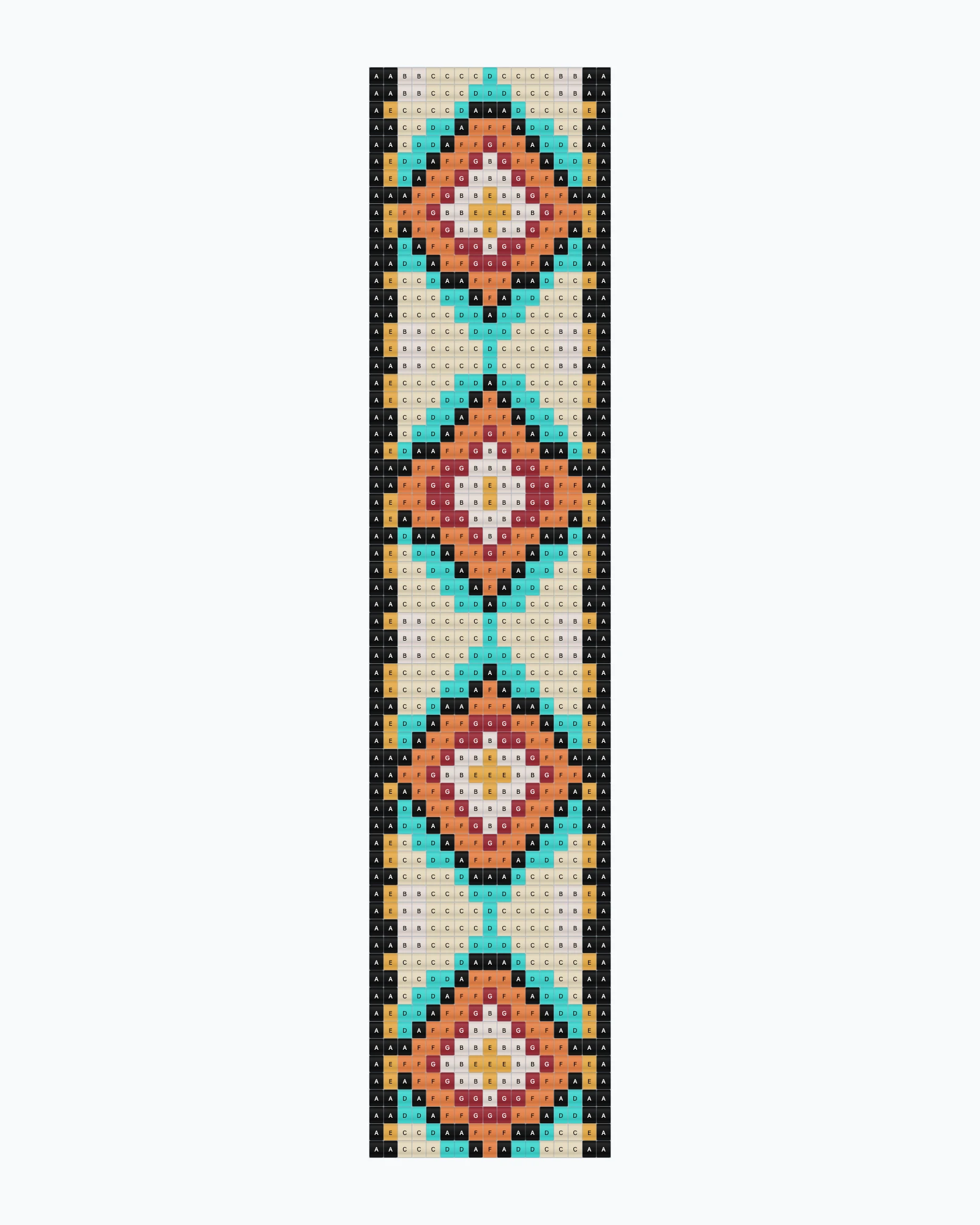
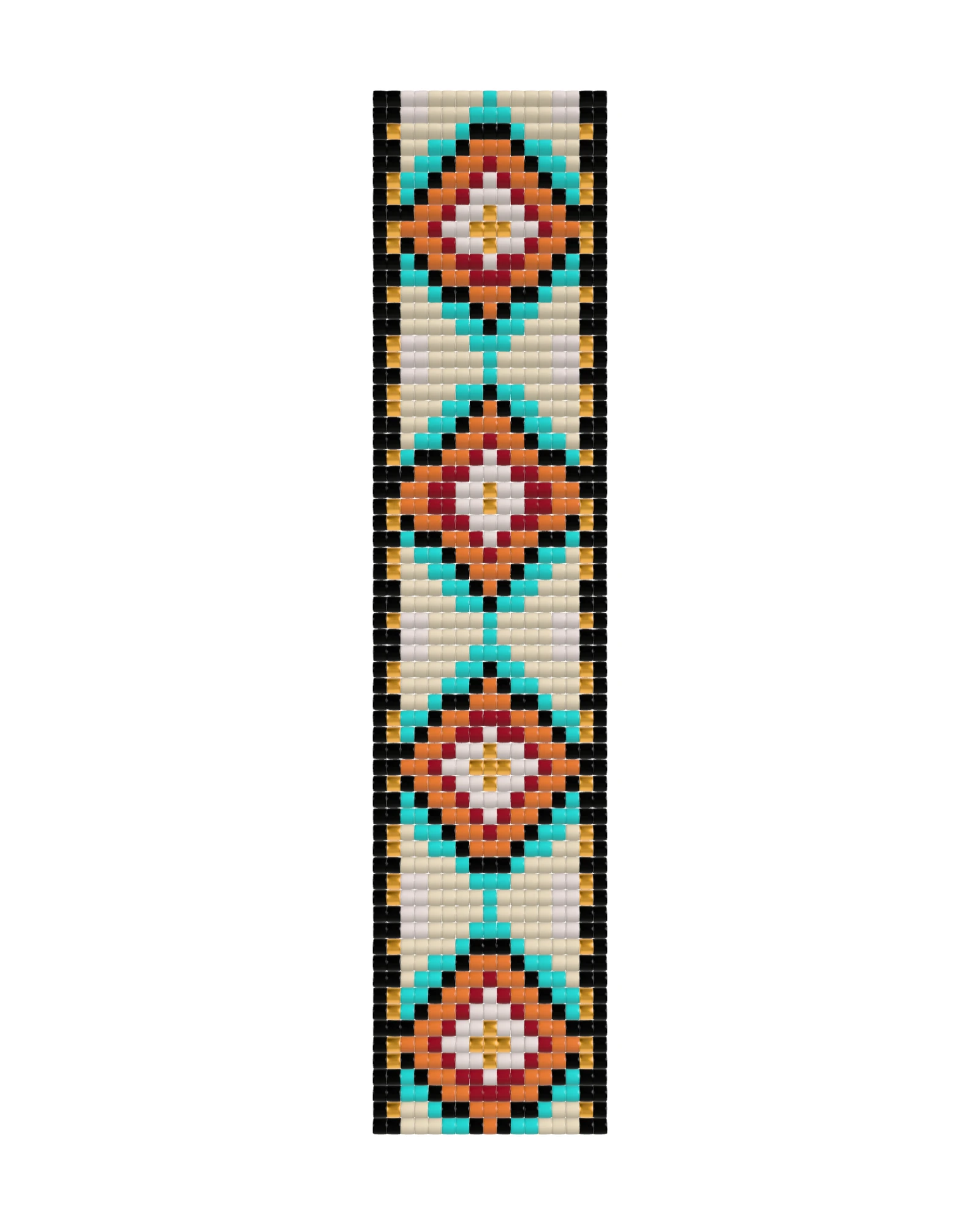
Check four things before you buy beads: where row 1 is, which way each row is read, where the repeat starts and ends, and whether the stated length includes the clasp. Many loom charts start at the top row; peyote charts are read in columns.
Which bracelet technique to use, with or without a loom
Six techniques cover most woven bracelets. They differ in tools and in how the beads sit, and so in the grid the chart is drawn on. A chart only works in the technique it was drawn for, unless two techniques share a grid.
| Technique | Loom? | Chart grid | How it feels | Best for |
|---|---|---|---|---|
| Loom weaving | Yes | Straight rows, cells a little taller than wide | Flat and even; quickest for long bands | Repeats, names, wide cuffs |
| Square stitch | No | The same straight grid as a loom | Firm; each bead is sewn on, so slower | Loom charts without a loom, short bands |
| Peyote (mosaic) | No | Staggered by half a bead | Smooth and supple, like fabric | Delica cuffs, diagonals, pictures |
| Brick stitch | No | Staggered: peyote turned a quarter | Smooth, easy to shape at the ends | Pointed or shaped ends, panels |
| Bead crochet rope | No, a hook | A spiral: rows of w and w + 1 | Round and soft | Bangles, spirals, polka dots |
| Right angle weave | No | Units of four beads | Open and very flexible | Light, lacy bands |
- Have a loom? Weave on it: it is the quickest way to a long, even band. Start with how to use a bead loom.
- No loom, but a loom chart? Use square stitch. It puts the beads on the same straight grid, so any loom chart works bead for bead.
- Want a supple cuff in Delicas? Use peyote. It needs a peyote chart: a loom chart woven in peyote leans.
- Want a round bangle? Crochet a bead crochet rope. A 19 cm bracelet six beads around takes about 620 Preciosa 10/0, 7 g.
- Want something light and open? Try right angle weave, also called cross weave, on one needle or two.
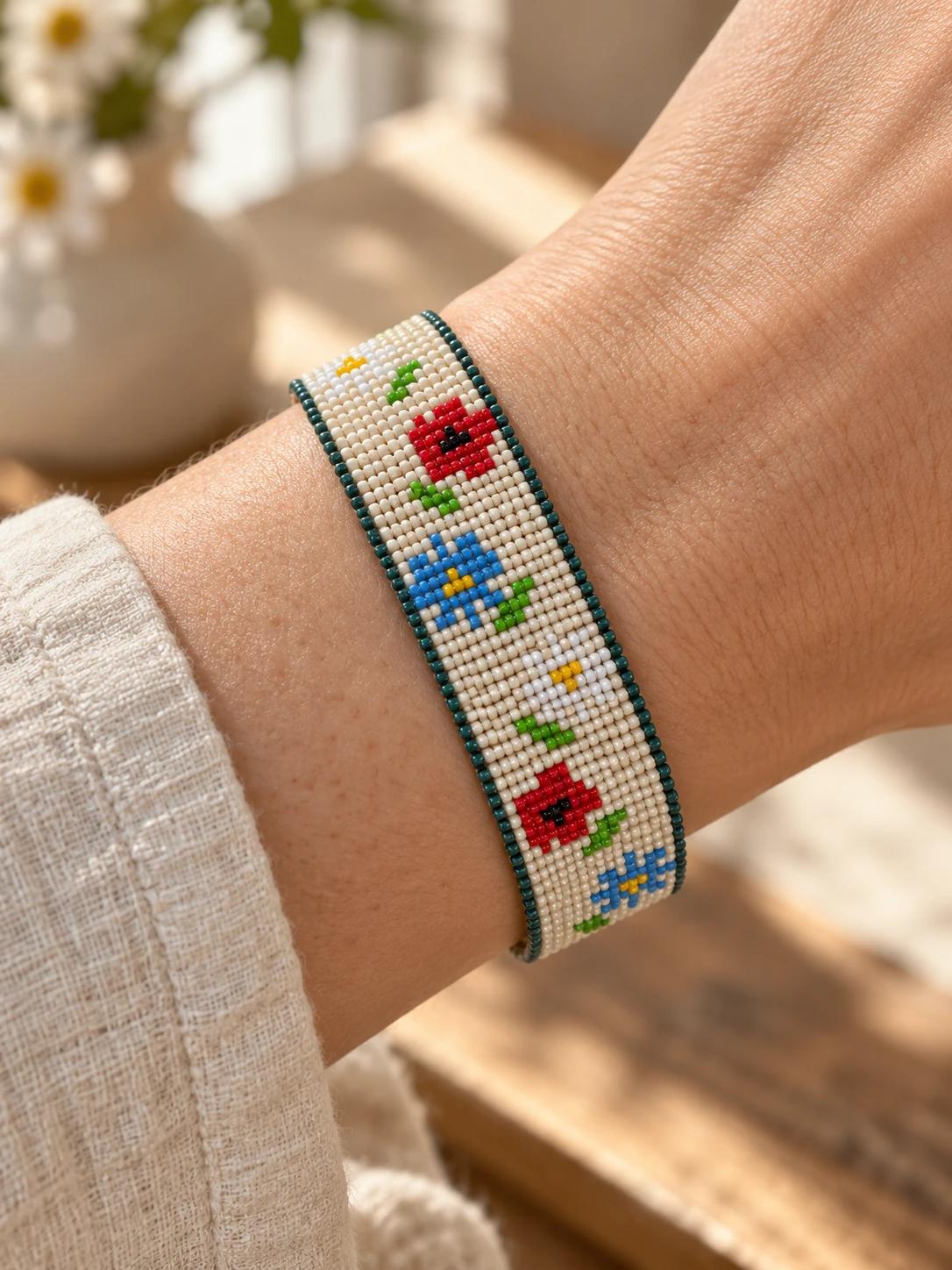
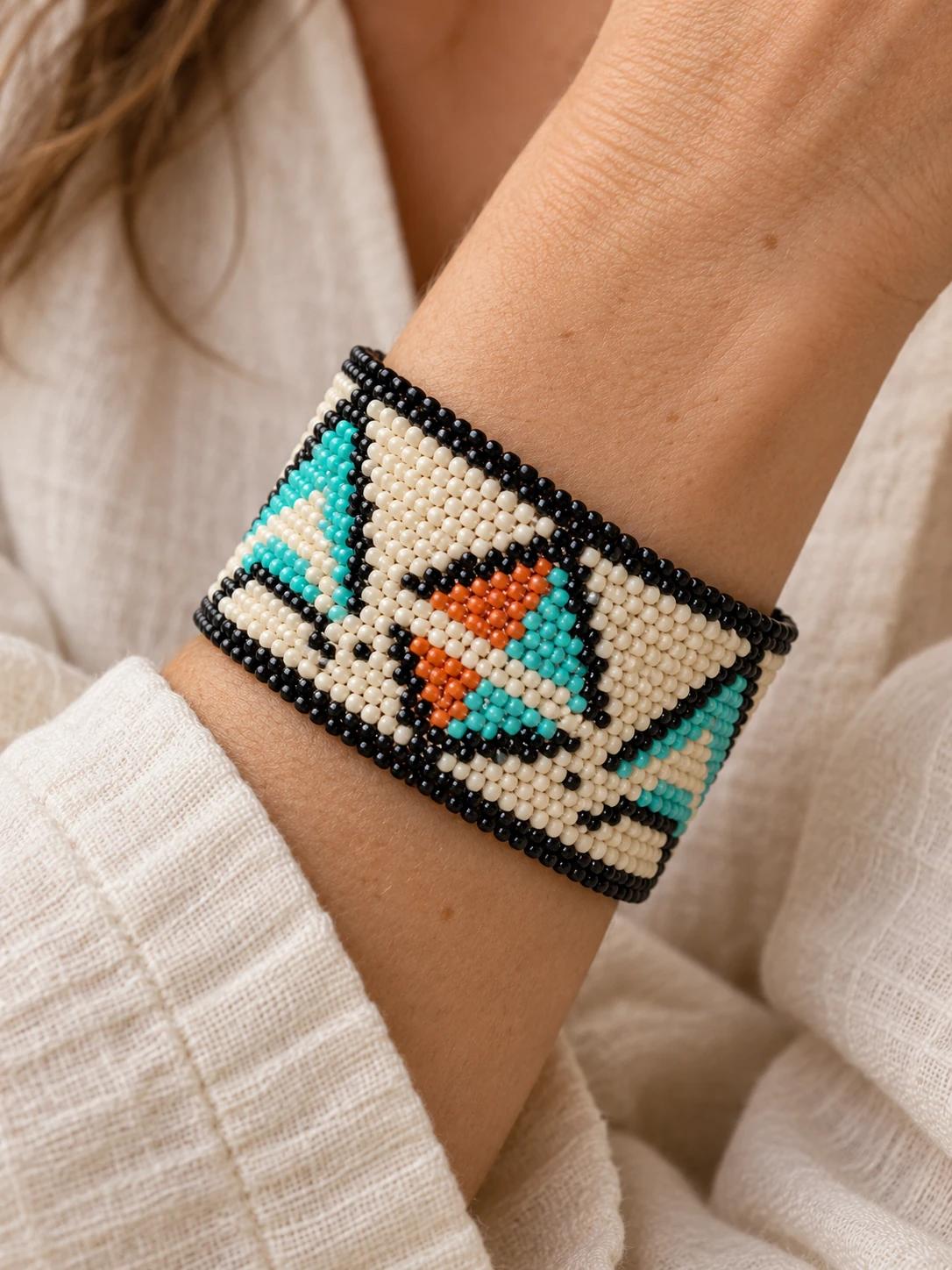
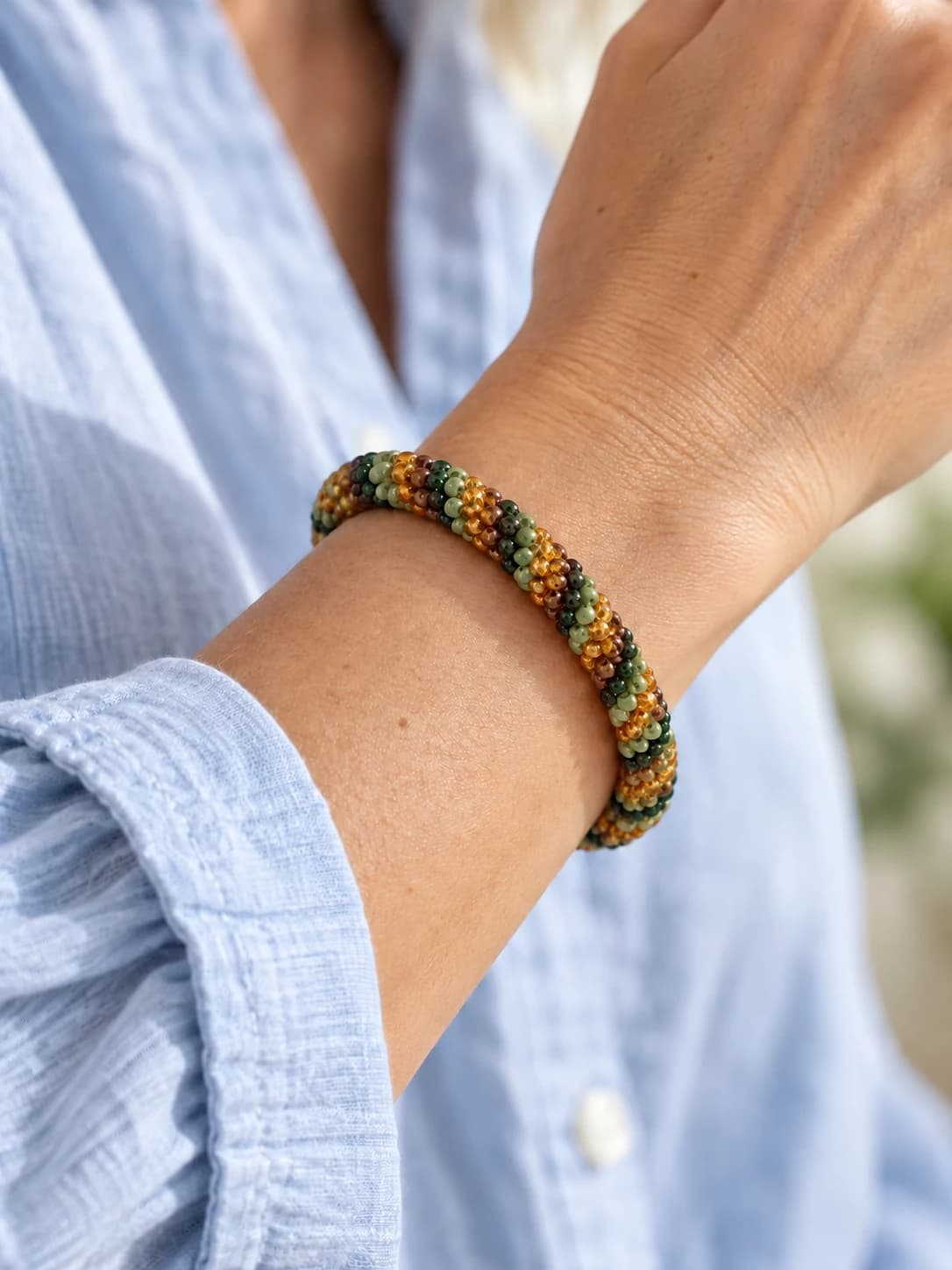
Strung and daisy-chain bracelets follow a written bead sequence instead of a grid, so they need no chart at all. For anything with a picture or a repeat, pick one of the six above; the guide to bead weaving stitches compares them in more depth.
How to measure your wrist and size a beaded bracelet
Wrap a soft tape measure, or a strip of paper you then lay on a ruler, round the wrist just below the wrist bone. Pull it snug but not tight. That number is the wrist, not the bracelet.
Add ease for the fit you want, then take away the clasp, because the clasp adds length too. What is left is the beaded band, the part the chart has to fill.
- 1Measure the wrist: say 16 cm.
- 2Add ease: 1 cm for a snug fit, 1.5 cm for comfortable, 2.5 cm for loose. Comfortable makes 17.5 cm from end to end.
- 3Subtract the clasp, measured closed: 17.5 - 1.5 = 16 cm of beaded band.
- 4Divide by the length of one row: the bead's diameter on a loom, 0.75 × the diameter in peyote and brick. 160 mm / 2.3 = 69.6, so 70 rows of Preciosa 10/0.
- 5Divide the width by the bead's pitch: 20 mm / 1.73 = 11.6, so 12 beads across. In peyote and brick take off half a bead: 20 / 1.3 - 0.5 = 14.9, so 15 Delica 11/0.
The table runs the same arithmetic for a 2 cm band, a comfortable fit and a 1.5 cm clasp. With those two settings the beaded band equals the wrist, which makes it easy to remember. The weight is the total divided by beads per gram: 91 for Preciosa 10/0, 200 for Delica 11/0.
| Wrist | Finished length | Beaded band | Preciosa 10/0, loom | Delica 11/0, peyote |
|---|---|---|---|---|
| 14 cm | 15.5 cm | 14 cm | 12 × 61 = 732 beads, 8.0 g | 15 × 117 = 1,755 beads, 8.8 g |
| 15 cm | 16.5 cm | 15 cm | 12 × 66 = 792 beads, 8.7 g | 15 × 125 = 1,875 beads, 9.4 g |
| 16 cm | 17.5 cm | 16 cm | 12 × 70 = 840 beads, 9.2 g | 15 × 134 = 2,010 beads, 10.1 g |
| 17 cm | 18.5 cm | 17 cm | 12 × 74 = 888 beads, 9.8 g | 15 × 142 = 2,130 beads, 10.7 g |
| 18 cm | 19.5 cm | 18 cm | 12 × 79 = 948 beads, 10.4 g | 15 × 150 = 2,250 beads, 11.3 g |
| 19 cm | 20.5 cm | 19 cm | 12 × 83 = 996 beads, 10.9 g | 15 × 159 = 2,385 beads, 11.9 g |
| 20 cm | 21.5 cm | 20 cm | 12 × 87 = 1,044 beads, 11.5 g | 15 × 167 = 2,505 beads, 12.5 g |
The quick bracelet bead calculator adds 1 cm and leaves the clasp out, so it gives a few more rows than this table: a safe upper count when you buy beads.
What size seed beads to use for bracelets
10/0 and 11/0 are the usual bracelet sizes: small enough for a clear motif on a 2 cm band, big enough to weave at a good pace. 8/0 makes a bolder, quicker band with less detail; 15/0 is for fine work.
Size numbers differ between brands, so compare millimetres. The table shows one bracelet, a 2 cm loom band 16 cm long, in five beads.
| Bead | Diameter | Beads across | Rows | Beads | Weight |
|---|---|---|---|---|---|
| Preciosa 8/0 | 2.9 mm | 10 | 56 | 560 | 13.3 g |
| Preciosa 10/0 | 2.3 mm | 12 | 70 | 840 | 9.2 g |
| TOHO Round 11/0 | 2.2 mm | 13 | 73 | 949 | 8.6 g |
| Miyuki Round 11/0 | 2.0 mm | 14 | 80 | 1,120 | 10.2 g |
| Miyuki Delica 11/0 | 1.6 mm | 16 | 100 | 1,600 | 8.0 g |
More beads across means more detail. Sixteen Delicas leave room for 7-bead letters and a border on each edge, while ten 8/0 beads suit chunky stripes and checks. Round beads give a textured surface; Delica cylinders sit flat like tiles, so lettering looks crisper. Preciosa, Miyuki and TOHO compared has the details.
Plan the width and make whole repeats fit
Width is a design choice, but it changes the fit. A narrow band bends easily round the wrist; a wide cuff is stiffer and needs more ease to slip on. These counts are for Preciosa 10/0 on a loom and Delica 11/0 in peyote.
- Narrow, about 1 cm: 6 Preciosa or 8 Delica. Stripes, small checks and stacking bracelets.
- Standard, 1.5-2 cm: 9-12 Preciosa or 12-15 Delica. Names, flowers and most repeats.
- Wide, about 3 cm: 18 Preciosa or 23 Delica. Bigger motifs with a border on both edges.
- Cuff, about 4 cm: 24 Preciosa or 31 Delica. Pictures and full ornaments.
Men's and wide bracelets
Men's bracelets often go wider and looser. For a 19 cm wrist, a 3 cm loom band with a loose fit (+2.5 cm) and a 1.5 cm clasp is 18 × 87 = 1,566 Preciosa 10/0, about 17.2 g. Two or three high-contrast colours, such as black, grey and one accent, keep a geometric motif bold.
From about 3 cm wide, plan the loose fit, because a wide band cannot curve as tightly round the wrist bone. On a loom, a 24-bead cuff needs 25 warp threads, so 50 ends to finish; a slide clasp as wide as the band holds it evenly. A peyote cuff has no warp ends at all.
Fit whole repeats into the band
Most bracelet patterns are a motif repeated down the band. If the band is not a whole number of repeats, the last motif is cut off at the clasp, and that is the first thing people notice. Work it out in rows:
- 1Count the rows in one repeat, including the gap before the next motif.
- 2Divide the band's rows by it. A 16 cm wrist in Preciosa 10/0 on a loom takes 70 rows.
- 3Half a repeat or less left over? Split it into plain rows at both ends. A 16-row repeat fits 4 times with 6 rows left: 3 plain rows at each end.
- 4More left over? Add a repeat and check the fit. An 18-row repeat fits 3 times with 16 rows left; 4 repeats are 72 rows, a 16.6 cm band and 18.1 cm finished, between comfortable and loose.
- 5Or tune the gaps: take one row out of each gap and 4 repeats of 17 rows make 68, plus 1 plain row at each end.
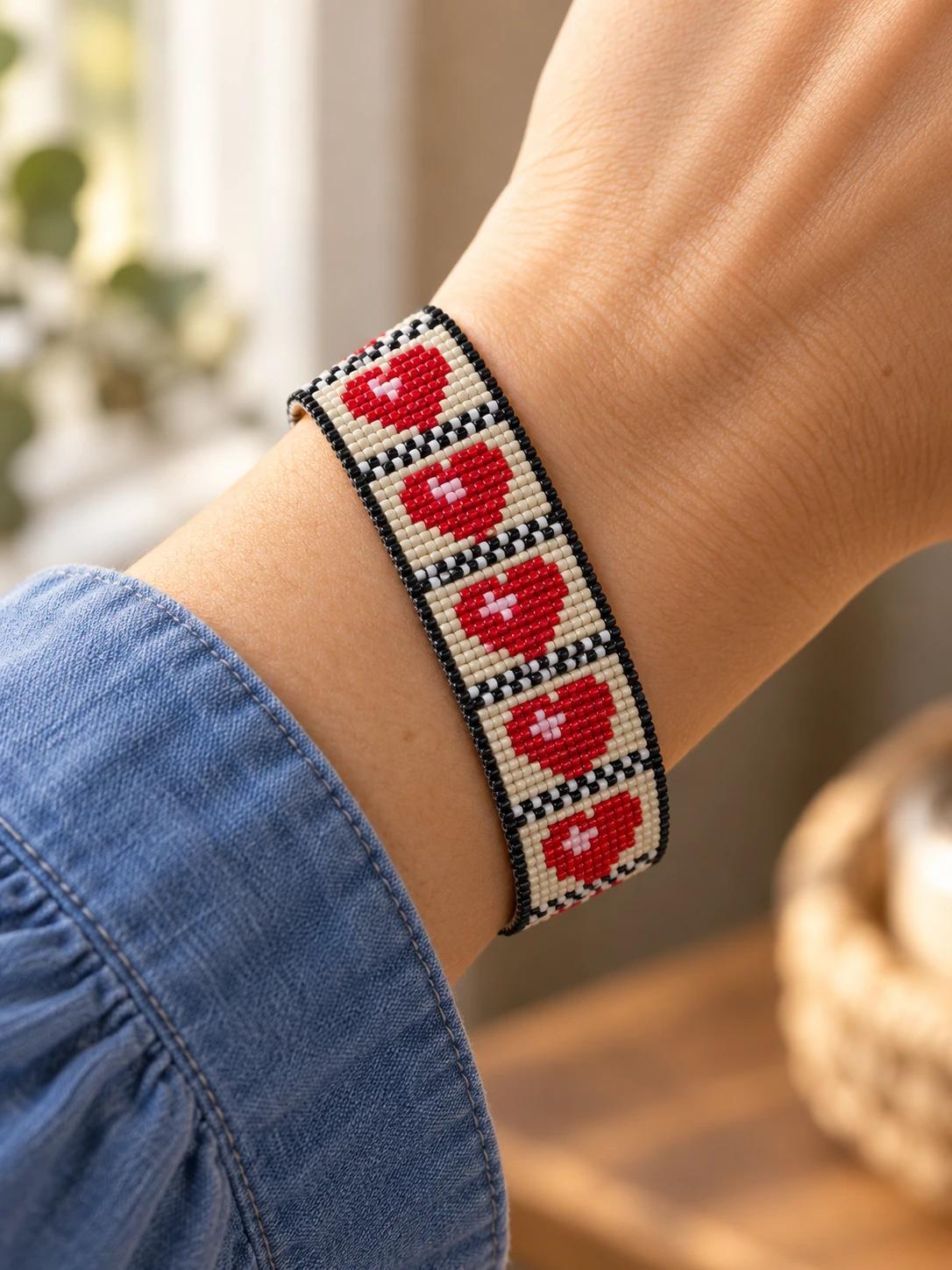
End both sides at the same point of the repeat, usually the middle of a gap, so the two ends match where the clasp meets. In Wevy, select one repeat and copy it down the band; when you resize for another wrist, you only move the end rows.
Motifs and colours that work on a beaded bracelet
Geometric motifs suit a narrow band best: diamonds, chevrons, zigzags, checks and stripes keep their shape at 9 to 15 beads across. Curves need width, so give a flower about 9 beads and a portrait a cuff.
Ukrainian embroidery motifs
Cross-stitch embroidery charts translate well, one stitch to one bead. Diamonds, eight-pointed stars and the wavy endless line come straight across, and regional embroidery palettes work as bead palettes: black and red as around Lviv, white, coral-red and black as around Kyiv, red, blue and black as in Volyn.
Mind the cell shape. A Preciosa 10/0 bead on a loom is 1.73 mm across and 2.3 mm along the band, so a motif charted on square embroidery cells comes out about a third longer. Take out about one row in four: a 16-row star becomes 12 rows. Delica 11/0 is closer to square, about one row in five.
Names, words and photos
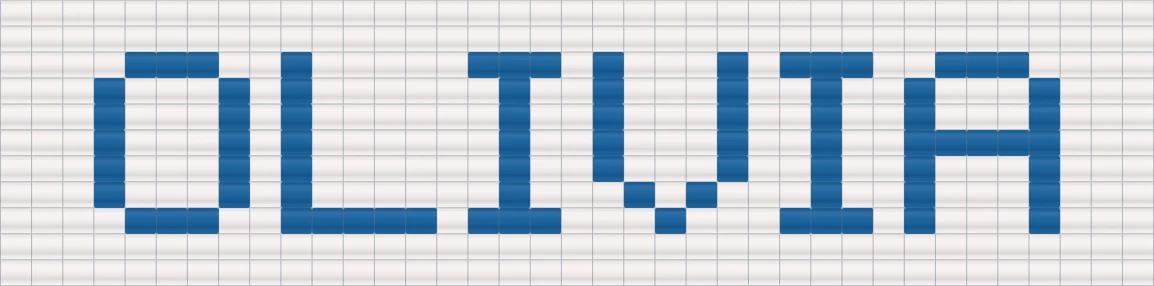
Letters need height. 7-bead capitals need a band at least 9 beads wide, one clear bead along each edge, which is about 1.6 cm in Preciosa 10/0. The free name bracelet pattern generator fits a name to your wrist on a loom or peyote band, in Latin or Ukrainian letters.
For a pet, a logo or a landscape, the image to bead pattern converter turns a picture into a loom or peyote chart in real bead colours. Crop tight and keep a bracelet to 6 to 10 colours; a band 12 beads wide has little room for detail.
Colours and bead count
Three to five colours are plenty for a first bracelet: a background, one or two motif colours and an edge. Put the strongest contrast between motif and background, and keep the edge columns one colour so the band looks straight. Bead colour combinations has palettes that work.
Buy per colour, not per bracelet, and add 10 to 15 percent for odd beads and spills. In Wevy the key counts every colour with its Preciosa, Miyuki or TOHO article number; how many beads you need shows the sums by hand.
How to finish a beaded bracelet and choose a clasp
Choose the finish before you start: it sets the clasp length you subtract, and some finishes need longer warp threads.
A loom band leaves two ends per warp thread, so 13 warps for a 12-bead band means 26 ends. Weave each one back through 4 or 5 rows and trim it, or knot them in pairs, glue the knots and hide them under an end bar.
- Slide clasp: a tube with loops that slides over the last row. Neat on loom and peyote bands; pick one as wide as the band.
- End bars and ribbon crimps: a bar pressed over a few rows of plain woven thread at each end, closed with a lobster clasp and jump rings. Press it onto thread, never onto glass beads, which can crack.
- Button and loop: a bead or button on one end, a loop of beads on the other. All beadwork and no metal; make the loop just big enough to pass the button.
- Magnetic clasp: easy to close with one hand, and a common way to close a bead crochet rope.
- Stitches with no warp: square stitch, peyote, brick and right angle weave leave only the working thread, so you sew the clasp loops straight to the edge beads.
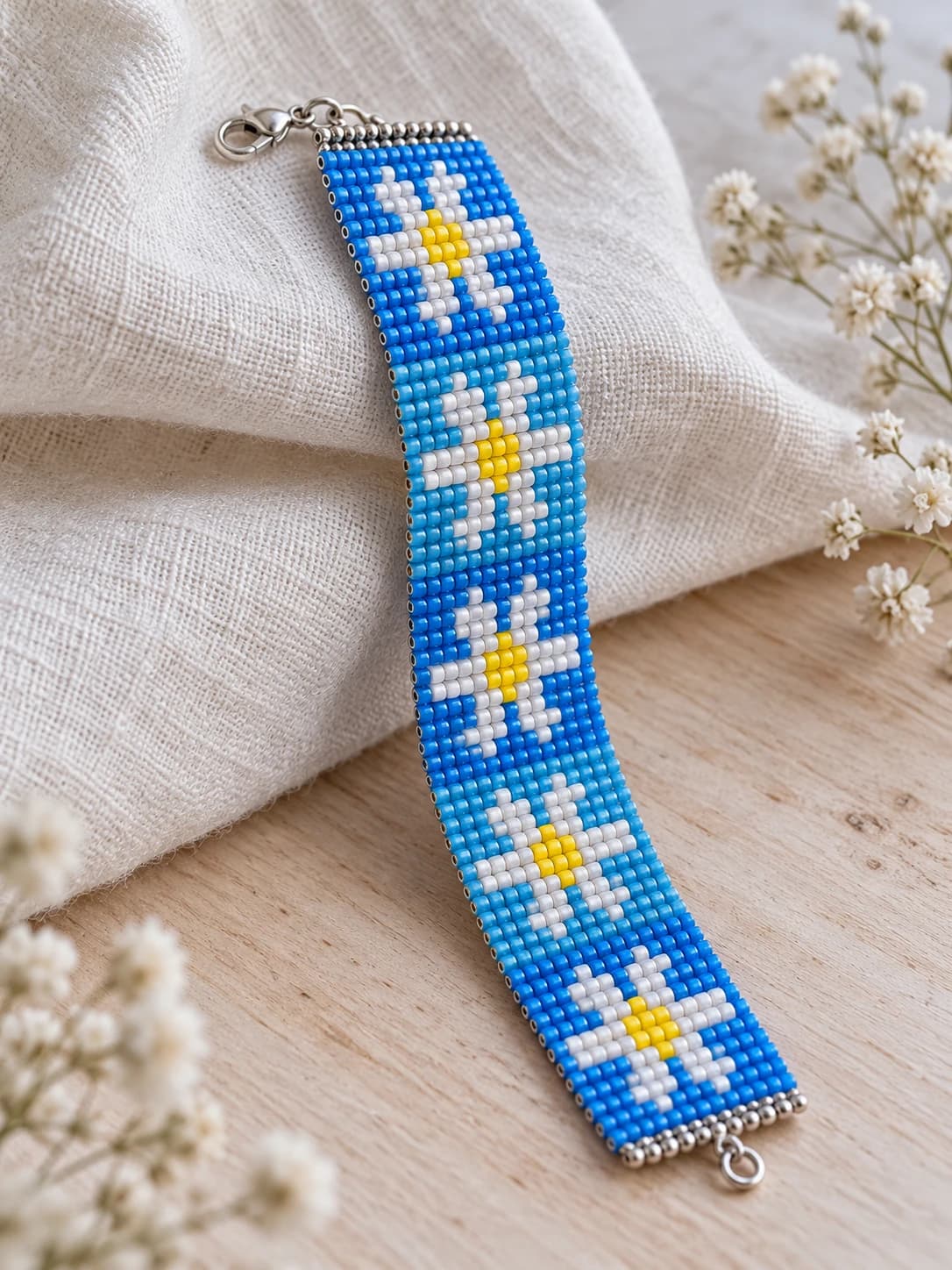
Weave a bracelet pattern row by row in Wevy
Wevy has a grid for each flat bracelet technique: the loom bracelet grid, square stitch, peyote and brick stitch are free, and the bead crochet rope grid comes with Hobby or Pro. Pick the bead from the real Preciosa, Miyuki or TOHO catalogue and the cells take its shape, so the chart looks like the band.
- 1Start a loom bracelet or peyote pattern and set the beads across and the rows from the planner above.
- 2Draw one repeat, then copy it down the band.
- 3Check the key's count per colour and turn the band in the 3D preview.
- 4Export a PDF chart with the key, or open Make mode and start weaving.
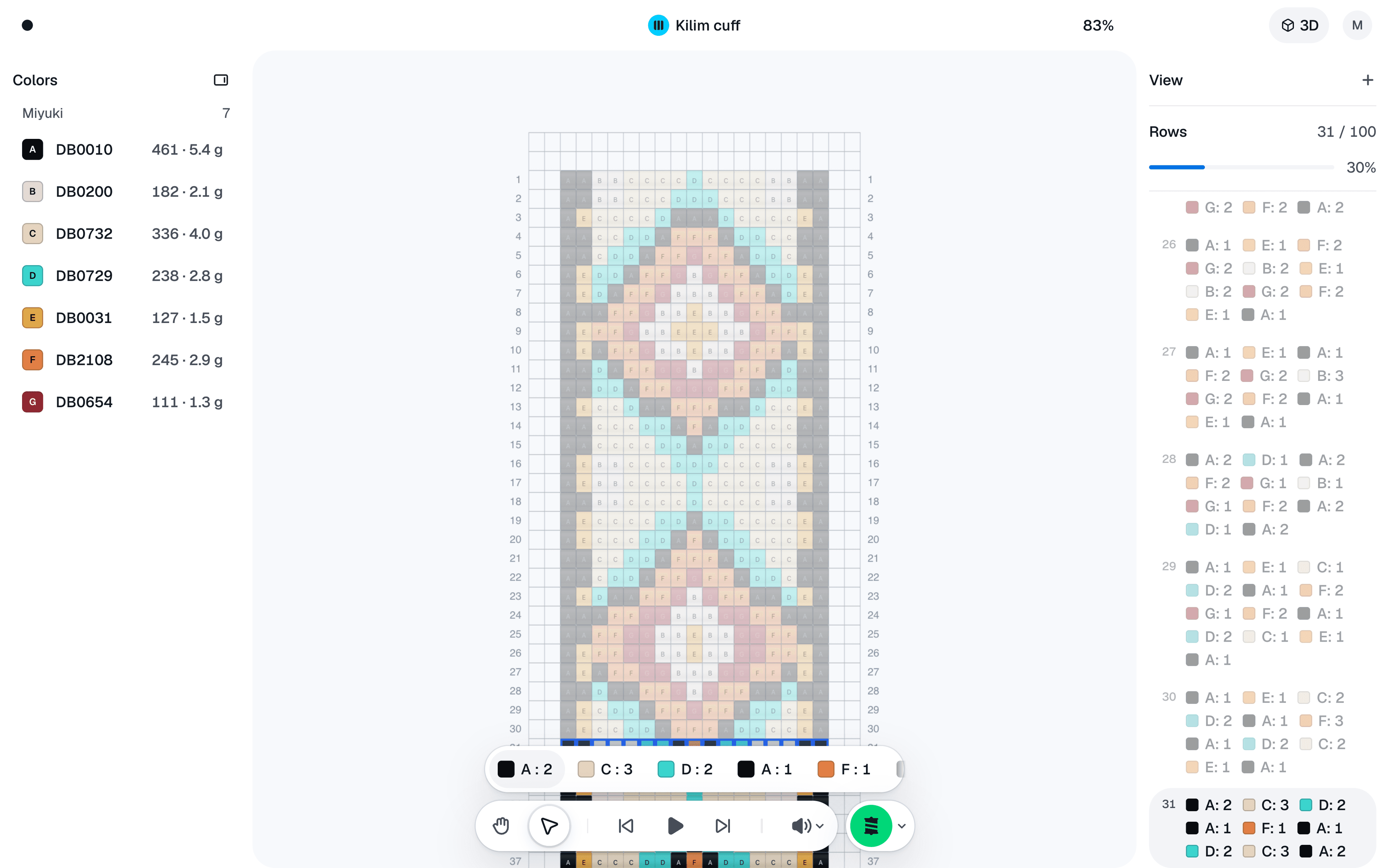
Make mode lights one row at a time and lists its colour runs in order, such as 2 A, 3 C, 2 D. Mark the row done and it moves on, keeps your place, and can read the runs aloud so your eyes stay on the beads. Peyote bands are walked column by column, the way they are woven.
Where to find free beaded bracelet patterns
The Wevy marketplace has free and paid bracelet patterns from independent designers, ready to open in Make mode. Making a pattern you got there is free on every plan. For a paid one, the designer sets the price and you arrange payment with them directly; Wevy takes no commission.
Pinterest boards and gallery sites are full of bracelet pictures, but many show a finished piece without a key. Before you start any free chart, check that it names the bead size, the beads across and the rows, the colours with article numbers, and the length it was drawn for. If the length is missing, rows × bead diameter gives it, and the planner above resizes it.
Or make your own: the name bracelet generator and the photo converter are free without an account, and bead graph paper prints a blank loom or peyote grid for pencil sketches.
Common mistakes and fixes
| What you see | Why, and how to fix it |
|---|---|
| The bracelet is too long once the clasp is on | The chart filled the wrist plus ease and the clasp went on top. Measure the clasp closed and subtract it from the finished length. |
| The last motif is cut off at the clasp | The band is not a whole number of repeats. Split the leftover rows between both ends, or add a repeat and check the fit. |
| The band is shorter than the chart promised | Your tension packs the rows tighter than average. Weave 10 rows, measure them and recount the rows from your own figure. |
| A loom chart leans when woven in peyote | Peyote shifts every other row by half a bead. Weave loom charts in square stitch, or redraw the design on a peyote grid. |
| An embroidery motif looks stretched | Loom beads are longer than they are wide. Take out about one row in four when you copy a cross-stitch chart for Preciosa 10/0. |
Questions beginners ask
What is the easiest beaded bracelet pattern for beginners?
A loom band 9 to 12 beads wide with 3 or 4 colours and a simple geometric repeat, such as diamonds or chevrons. Without a loom, the same chart works in square stitch. Even-count peyote is the easiest staggered stitch to start with.
How long should a beaded bracelet be?
Your wrist plus ease: 1 cm for a snug fit, 1.5 cm for comfortable, 2.5 cm for loose. A 16 cm wrist with a comfortable fit makes a 17.5 cm bracelet from end to end, clasp included.
What size seed beads are best for bracelets?
10/0 and 11/0, most often Preciosa 10/0 or Miyuki Delica 11/0. They give 12 to 16 beads across a 2 cm band, enough for clear motifs and names. 8/0 is quicker and bolder but holds less detail.
How many beads do I need for a beaded bracelet?
A 2 cm loom band in Preciosa 10/0 for a 16 cm wrist, with a comfortable fit and a 1.5 cm clasp, is 12 × 70 = 840 beads, about 9.2 g. The same band in Delica 11/0 peyote is 2,010 beads, about 10.1 g. Add 10 to 15 percent of each colour.
Can I make a loom bracelet pattern without a loom?
Yes. Square stitch puts the beads on the same straight grid, so a loom chart works bead for bead with only a needle. It is slower, but leaves no warp ends to finish.
Where can I find free beaded bracelet patterns?
The Wevy marketplace has free bracelet patterns you can make in Make mode on any plan. The name bracelet generator and the photo converter make a chart for free without an account. Check any free chart for its bead size and length before you buy beads.
How wide should a men's beaded bracelet be?
Usually 2 to 3 cm. A 3 cm band is 18 Preciosa 10/0 across on a loom or 23 Delica 11/0 in peyote. Wide bands need the loose fit, wrist plus 2.5 cm, because they curve less.
How do I make a repeating pattern fit my wrist?
Divide the band's rows by the rows in one repeat. Split a small remainder into plain rows at both ends; if more than half a repeat is left, add a repeat and check the finished length stays 1 to 2.5 cm over the wrist.