Short answer
A gerdan pattern is a loom chart for a Ukrainian beaded necklace: two neck straps and two mirrored halves, split by a one-bead gap, that join into one panel ending in a point. Plan it in beads: panel width = 2 × strap width + 1, rows = length ÷ bead diameter. Then mirror the halves and centre the motif.
What you need
- Your neck measurement and where the panel should sit
- A bead loom with room for the panel width plus one warp thread
- Round seed beads 10/0, for example Preciosa, in 3 to 6 colours
- Beading thread for the warp and the working thread, and a long beading needle
- Graph paper in the bead's real proportions, or a gerdan editor
Words the chart uses
- Strap
- One of the two bands that go around the neck. In the size planner it means everything above the join.
- Gap
- The empty column between the two halves. On the loom it is one space between warps with no bead in it.
- Join
- The first row that runs the full width, where the two halves become one panel.
- Panel
- The widest part, below the join. It carries the main motif and ends in a point.
- Centre column
- The middle column of the panel. The motif is mirrored about it, and the point ends on it.
- Warp
- The lengthwise threads on the loom: one more than the beads in the widest row.
What is a gerdan, and how is it different from a sylianka?
A gerdan (ґердан) is a beaded neck ornament from western Ukraine: the Hutsul region, Pokuttia, Boykivshchyna, Opillia and Bukovyna. The name goes back to the Turkic word gerdan, "neck", which is also why an English search for gerdan turns up Turkish gerdanlık necklaces.
In July 2023 Ukraine added the traditional women's beaded ornaments of Prykarpattia to its National List of Intangible Cultural Heritage. The listing, as reported by UNN, describes the gerdan as a band of many-coloured beads shaped like a flat chain or an openwork collar, worn on the neck or on the head, and gives its other local names: sylianka, stronchka and luchka.
Gerdan or sylianka?
Because the names overlap from village to village, a museum label doesn't tell you the technique. Makers today use them more strictly: a gerdan is woven on a loom, or in square stitch, into a solid band of upright cells, and a sylianka is an open net of diamonds strung by hand. Wevy names its grids the same way, and the sylianka design guide covers the netted kind. Solid gerdans come in several shapes:
- Ribbon gerdan (стрічковий): one narrow band tied at the neck. A loom-woven one from 1880-1900 in the National Museum of the History of Ukraine is 27 × 2.5 cm and fastens with ties.
- Gerdan with a panel or medallion: two straps that meet at a wider piece on the chest. This is the shape Wevy's gerdan chart draws, as one loom piece.
- Corner gerdan (кутовий): a band that turns a sharp V at the front and sits like an embroidered collar.
- Sewn gerdan: beads stitched onto a ribbon. An early 19th-century one in the Museum of Fine Arts of Prykarpattia is 48.5 × 2 cm, with white hooks on red wool.
What is Lesya Ukrainka's gerdan?
Makers use "Lesya Ukrainka's gerdan" for a narrow band worn close to the neck, copied from photographs of the poet in Ukrainian dress. The photos are black and white, so the colours of every modern chart are a reconstruction, and a local museum in Volyn notes that in her time such a choker was called a sylianka. Plan it as a ribbon gerdan: 12 to 14 beads of Preciosa 10/0 make a band 2.1 to 2.4 cm wide.
Parts of a gerdan pattern and their proportions
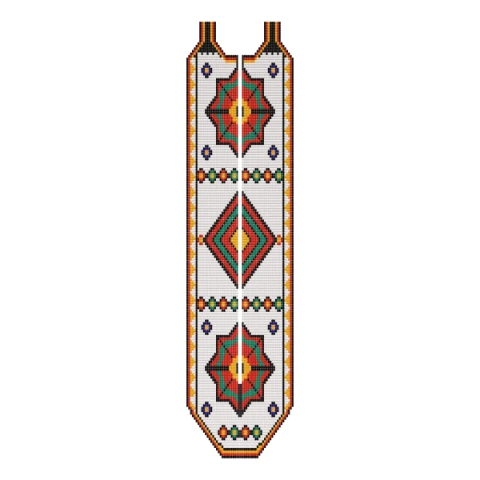
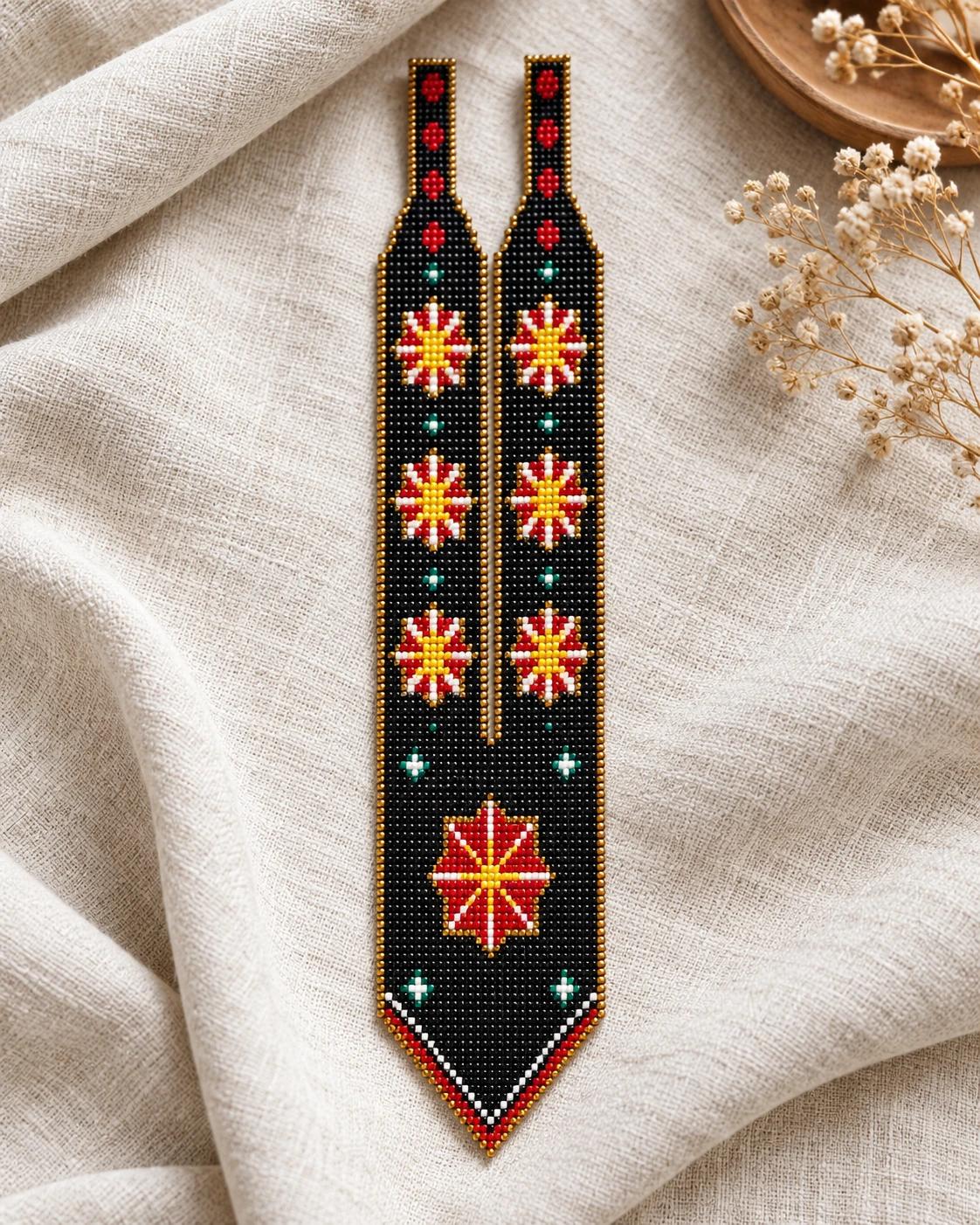
A Wevy gerdan is one piece of loom weaving. Two neck straps run down from the back of the neck, become two mirrored halves split by a one-bead gap, and join lower down into one panel that ends in a point. Nothing is sewn on: straps, halves and panel share the same warp.
Because the halves sit side by side on the loom with one empty bead between them, the panel is always 2 × strap width + 1 beads wide: 7 + 1 + 7 = 15, 10 + 1 + 10 = 21, 20 + 1 + 20 = 41. An odd panel has a true centre column, and that matters for symmetry later.
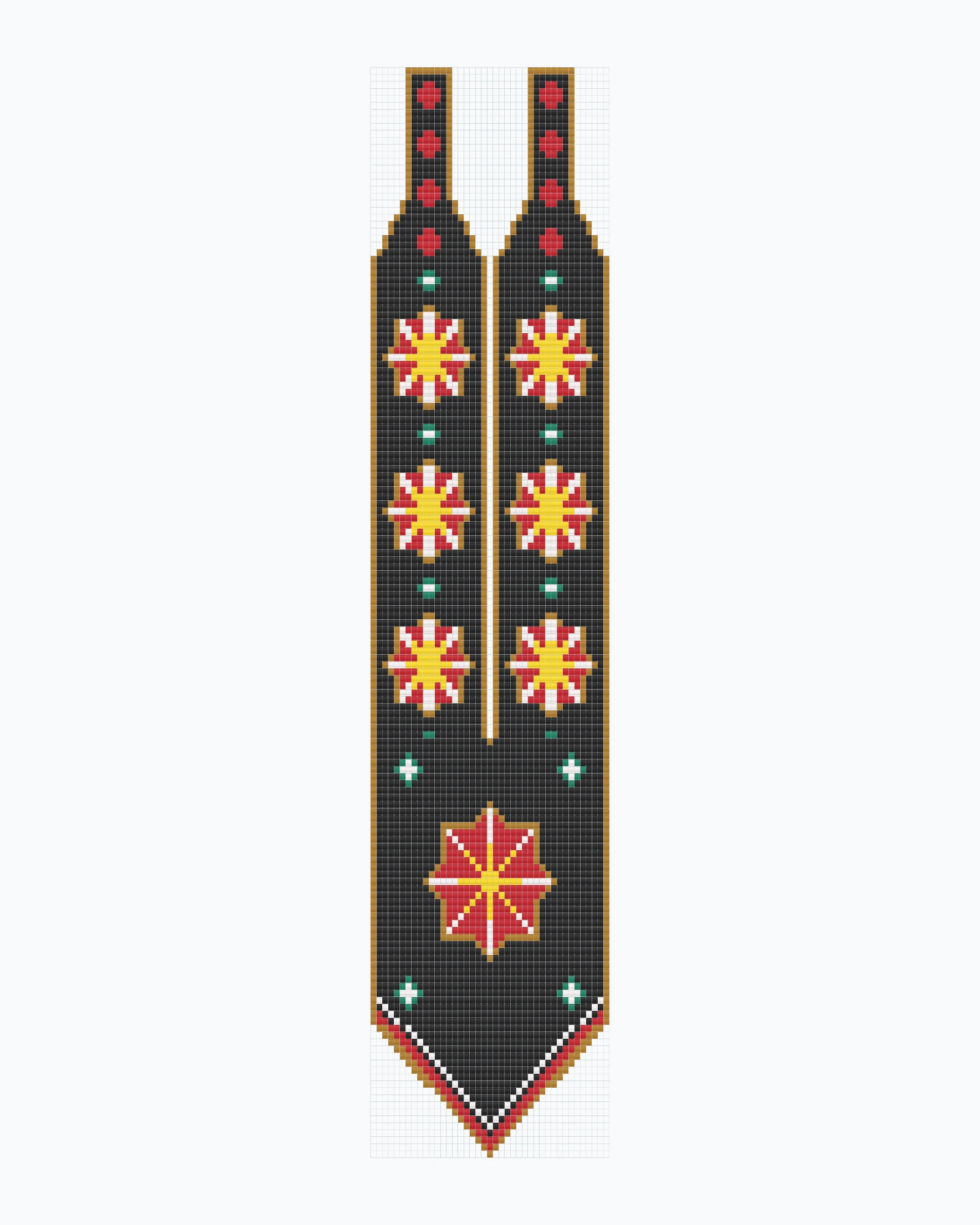
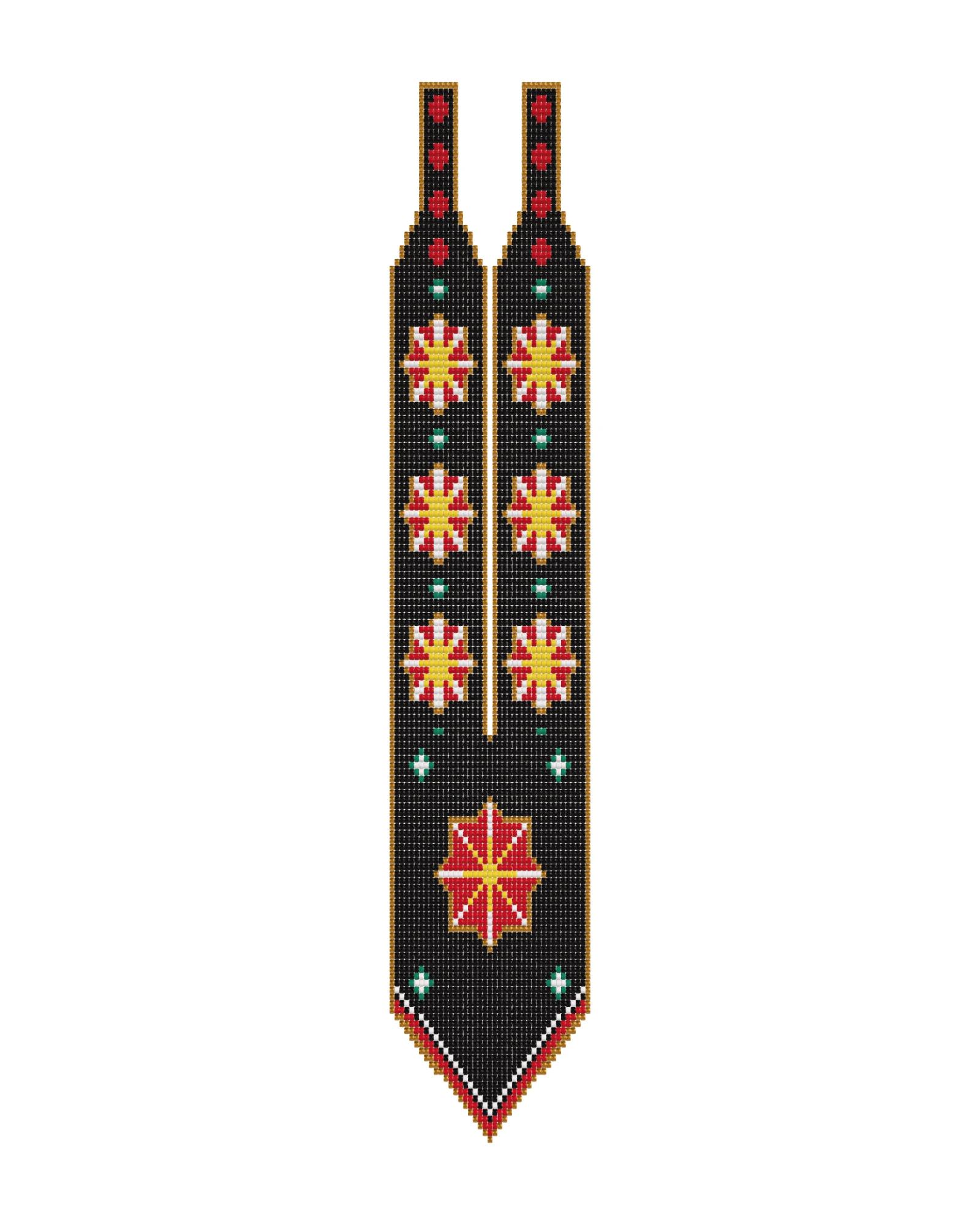
- Neck straps: the top ends, finished with ties or a clasp. They can keep the halves' width or narrow towards the neck, as in the chart above.
- Halves: the lower part of each strap, lying on the chest. One is the mirror image of the other.
- Gap: one empty column between the halves. It lets them open into a V when the gerdan is worn.
- Join: the first full-width row. From here one working thread carries the whole row.
- Panel: the widest part and the home of the main motif.
- Point: the panel's last rows, one bead shorter on each side per row, ending in a single bead on the centre column.
The chart above is 41 beads wide: two 20-bead halves and the gap. In Preciosa 10/0 that is about 7.1 cm across, and the loom needs 42 warp threads for it.
How big should a gerdan be?
Plan the size before the motif, because the motif has to fit the beads you have. Start with the strap length: run a tape measure from the back of your neck down to where the panel should begin. To slip a gerdan over the head without a clasp, the two straps together need about 66 cm, so 33 cm each, the length a published split-loom necklace tutorial gives for most adults. With ties or a clasp they can be shorter.
Then choose the bead and the width. Beads across follow the bead's pitch and rows follow its diameter, so the same chart changes size with the bead: on a loom each Preciosa 10/0 adds 1.73 mm across and 2.3 mm down, each Miyuki Delica 11/0 only 1.3 mm and 1.6 mm.
The planner counts each strap as everything above the join, at the strap's width. Rows are the length divided by the bead diameter, rounded up. The point narrows one bead on each side per row, so it takes half the panel width in rows, rounded up: 11 rows, about 2.5 cm, for a 21-bead panel in Preciosa 10/0. If your straps narrow near the neck, plan with the wider half; the small overcount becomes spare beads.
| Gerdan | Each strap | Panel | Rows: strap / panel (point) | Beads | Weight |
|---|---|---|---|---|---|
| First gerdan, with ties | 7 beads (1.2 cm), 25 cm | 15 beads (2.6 cm), 7 cm | 109 / 31 (8) | 1,935 | 21 g |
| Classic | 10 beads (1.7 cm), 30 cm | 21 beads (3.6 cm), 10 cm | 131 / 44 (11) | 3,434 | 38 g |
| Wide, slips over the head | 20 beads (3.5 cm), 33 cm | 41 beads (7.1 cm), 16 cm | 144 / 70 (21) | 8,210 | 90 g |
| Classic in Delica 11/0 | 10 beads (1.3 cm), 30 cm | 21 beads (2.7 cm), 10 cm | 188 / 63 (11) | 4,973 | 25 g |
Two things stand out. A wide gerdan is mostly straps: in the 41-bead example they take 5,760 of the 8,210 beads. And the same 21-bead chart woven in Delica 11/0 is about a quarter narrower and needs 57 more rows per strap for the same 30 cm, which is why a chart drawn for one bead rarely fits another. The bead count guide explains the method for any piece.
How to choose gerdan motifs, from stars to viburnum and poppies
A gerdan has three places for motifs, and each takes a different size. The panel carries the main motif, the halves carry a repeat, and the strap ends near the neck carry the smallest pattern, because they sit at the back.
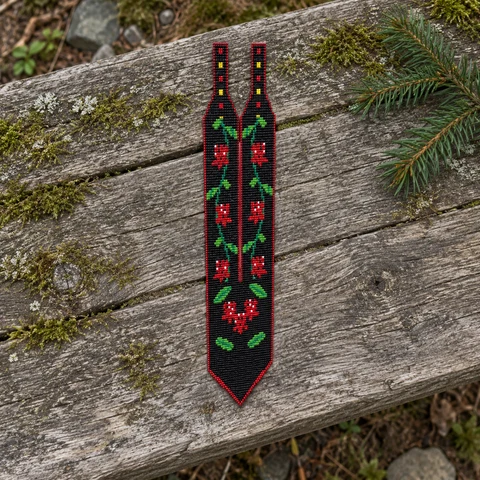
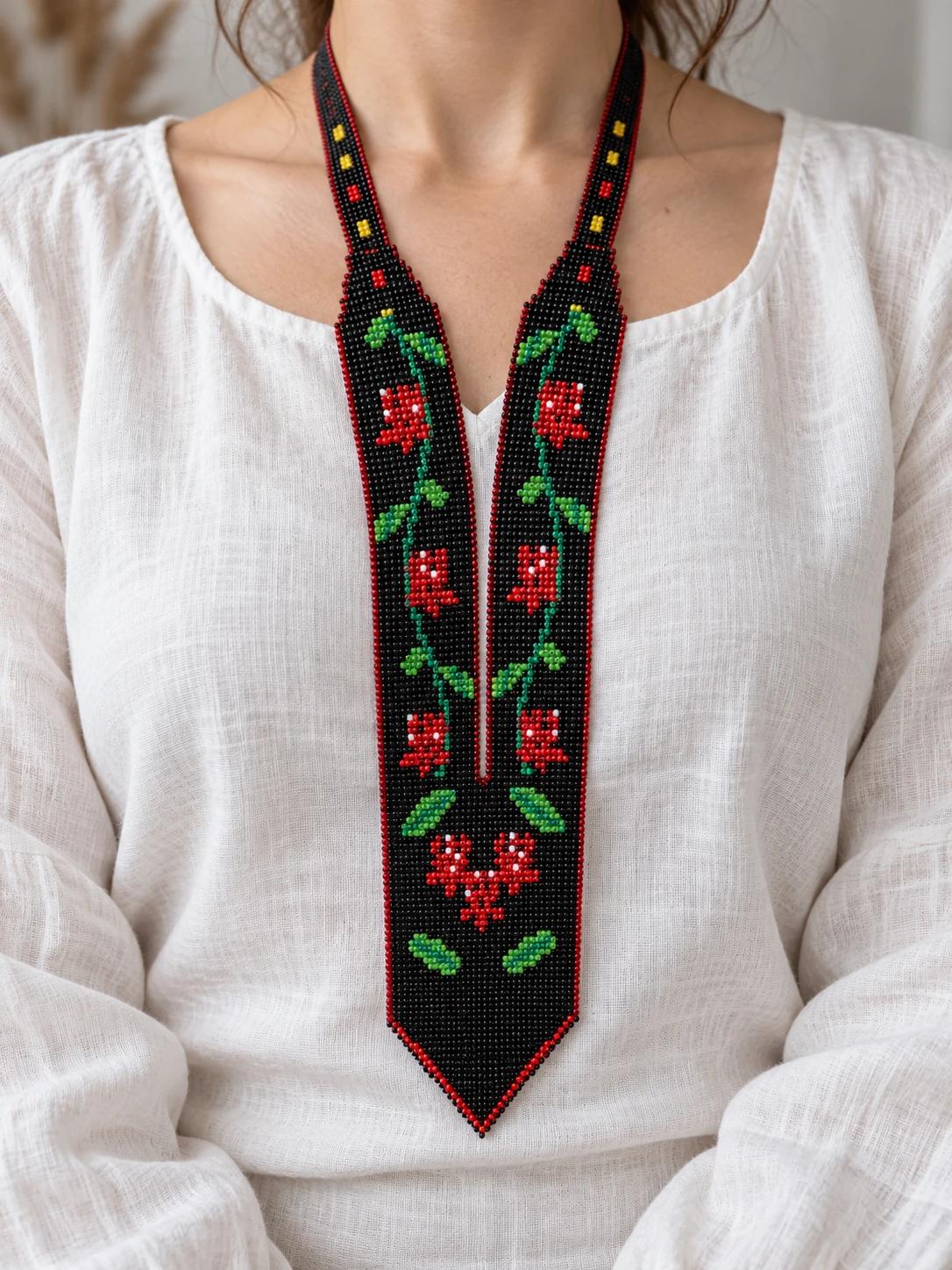
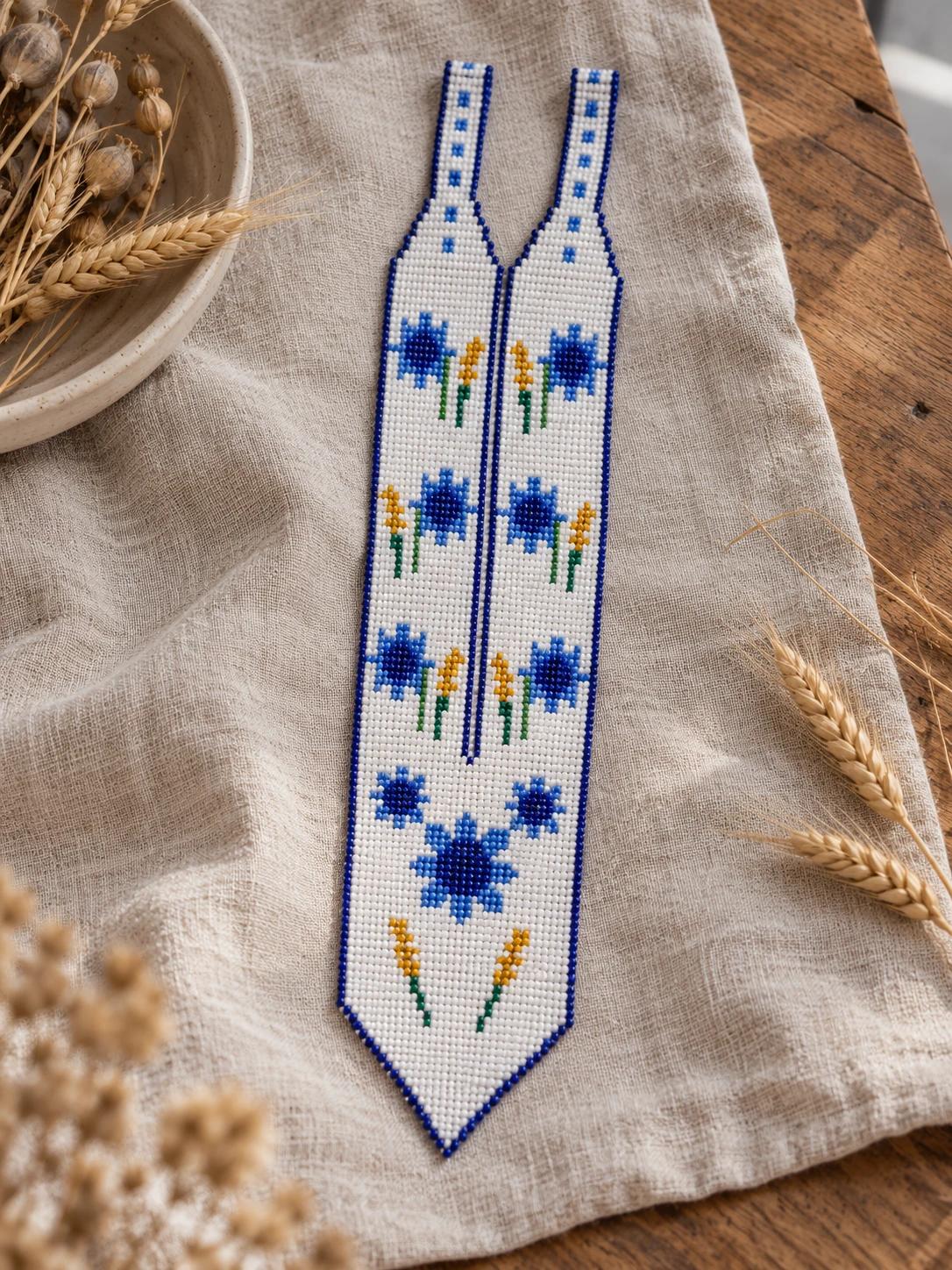
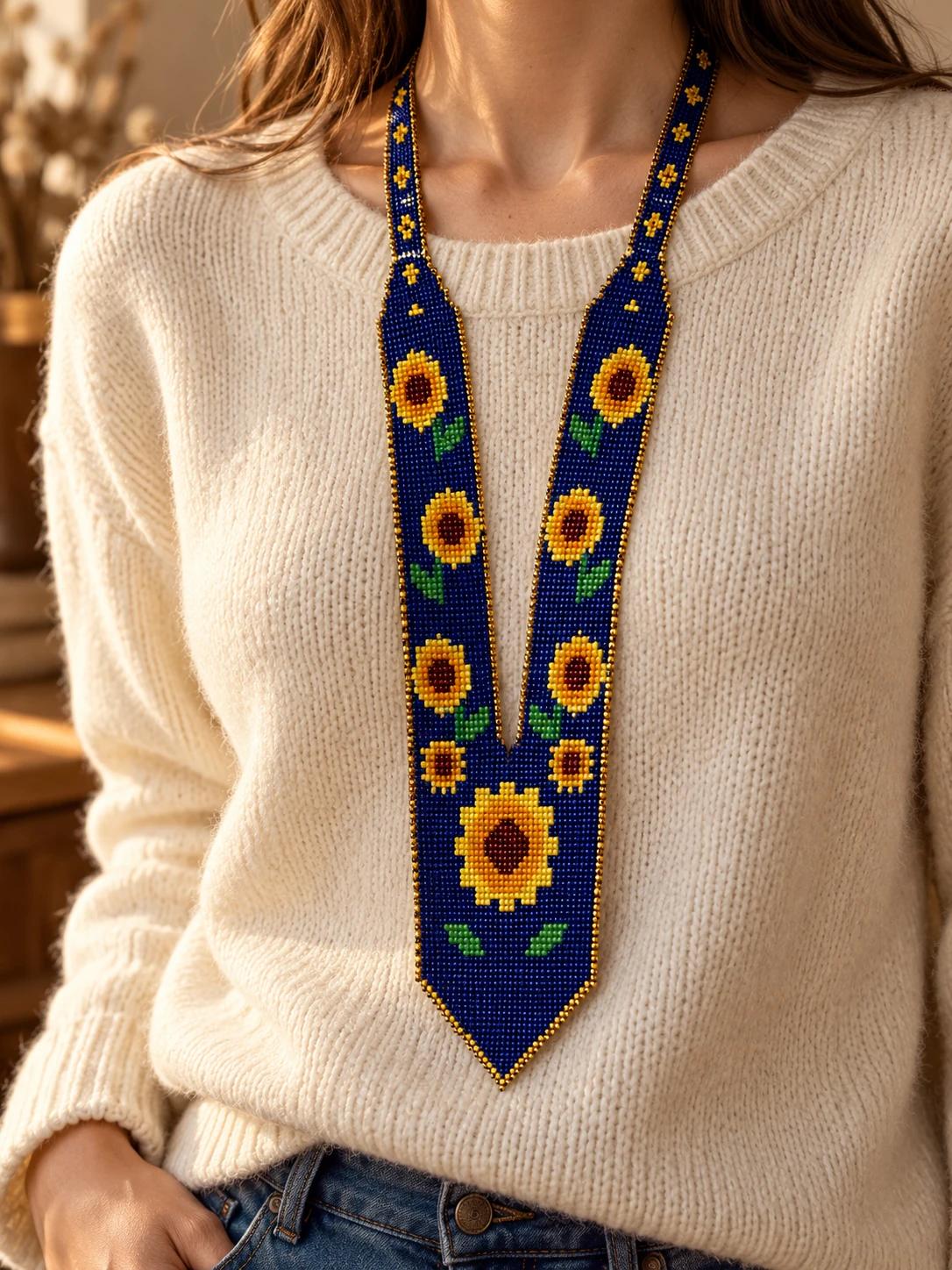
Older pieces lean on geometry: rhombuses, crosses, hooks, zigzags and eight-pointed stars. Modern gerdans add the flowers Ukrainians also embroider, such as viburnum (калина), poppies, cornflowers and sunflowers, often with wheat or leaves.
| Motif | Minimum width | Colours | Best place |
|---|---|---|---|
| Rhombus or cross | 5 beads | 1 plus the ground | Straps, halves, borders |
| Eight-pointed star | 9 beads; 13 to 17 look best | 2 to 3 | Wide halves or the panel |
| Viburnum cluster | 9 beads | 2 reds and a green | Halves and panel |
| Cornflower | 7 beads | 2 blues | Halves |
| Poppy | 11 beads | 2 reds, a black centre, green | Panel |
| Sunflower | 11 beads | 2 yellows and a brown | Panel |
Then fit the motif to the space. A 10-bead strap with a one-bead edge on each side leaves 8 beads, so motifs 8 or 6 wide sit centred; a 7-bead motif would sit half a bead off. On a 21-bead panel, odd widths centre on the middle column: a 15-bead star leaves 3 beads of ground on each side.
Meanings are part of the appeal, but don't overclaim them. A third-generation gerdan maker told Suspilne in 2023 that a rhombus stands for prosperity and a cross inside it protects, while a Kosiv researcher noted that almost every mountain village had its own gerdans. Treat symbols as stories that change from village to village, not as rules.
Choosing gerdan colours that read from a distance
Old gerdans are anything but muted. The early 19th-century one in the Museum of Fine Arts of Prykarpattia sets white hooks among green, blue and cherry beads on red wool; the loom-woven one from 1880-1900 uses blue, green, light blue, red, white and silver. The national listing names rich, many-coloured palettes as the mark of Prykarpattia gerdans.
What makes a palette work is contrast in lightness, not the number of colours. Choose the ground first, then one or two colours that still stand apart from it in a black and white photo.
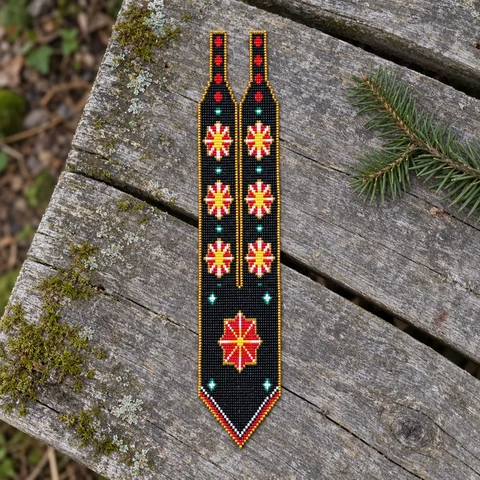
- Black ground with red, gold, white and a little green: the star gerdan in this guide, six colours in all.
- White ground with two blues and a yellow: cornflowers and wheat.
- Navy ground with yellow, brown and green: sunflowers.
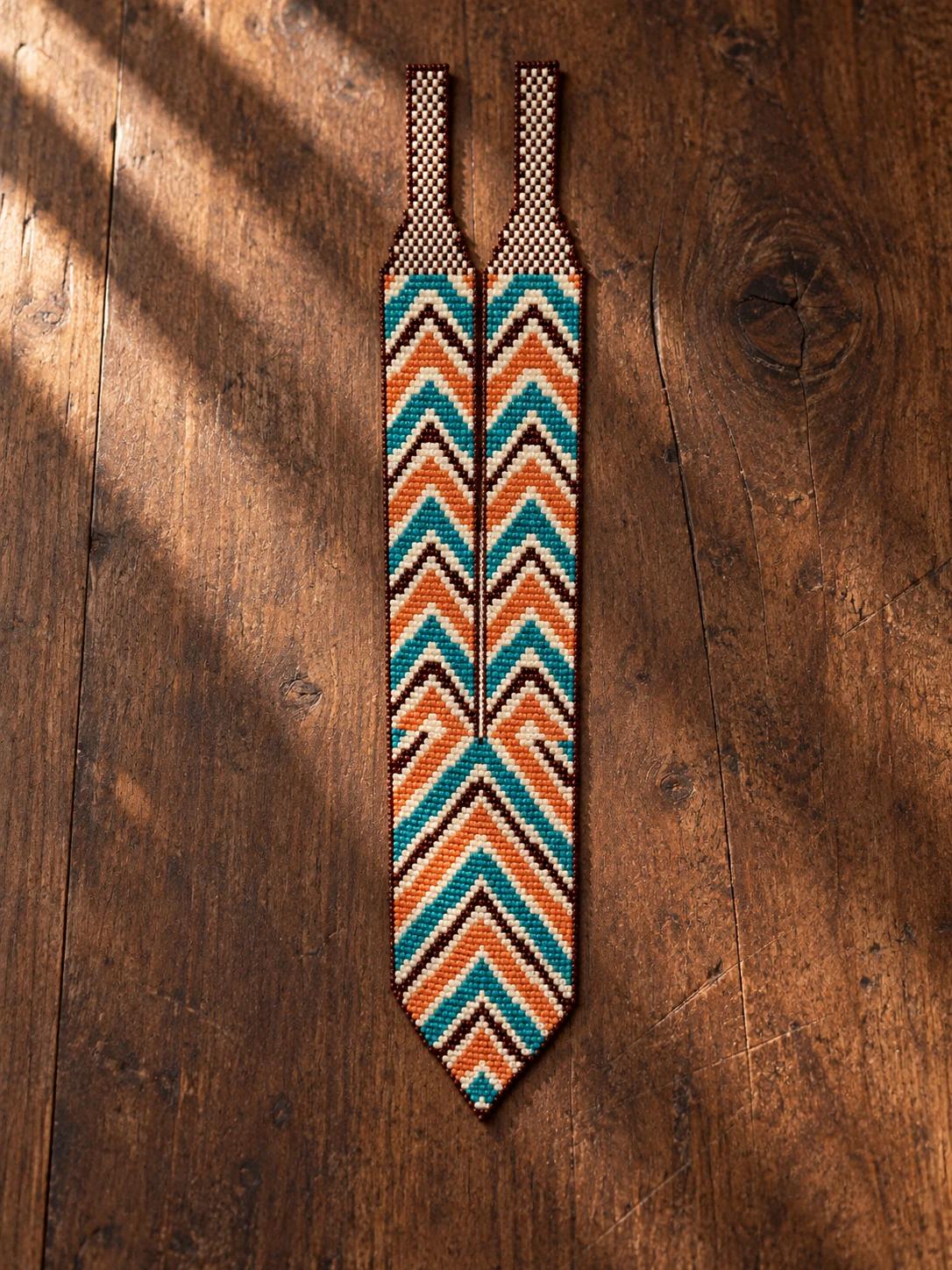
- Terracotta, cream, teal and dark brown in equal stripes: geometric chevrons with no ground at all.
Three to six colours are enough for most gerdans. Add a one-bead edge in a contrast colour, like the gold one in the chart above: it outlines the halves, the gap and the point, so the shape reads from across a room. For more pairings, see bead colour combinations.
Buy by article number, not by colour name. Round Preciosa 10/0 is the traditional gerdan bead, and Wevy's catalogue has 1,673 Preciosa colours with their article numbers, so the chart's key doubles as a shopping list. If you prefer Japanese beads, the Preciosa, Miyuki and TOHO comparison shows what changes in size and look.
Symmetry, mirroring and the centre column
A gerdan has two axes of symmetry. Above the join, the right half mirrors the left across the gap. Below it, the panel's motif is symmetrical about the centre column: the column that was the gap higher up and that ends in the point's last bead.
Mirror, don't copy. A cornflower whose stem leans left, copied to the right half, leans left there too and the piece looks lopsided; mirrored, both stems lean towards the centre. Motifs that are symmetrical on their own, like stars, rhombuses and the chevrons below, look the same either way.
- 1Draw the left half from the neck end down to the join, and leave the gap column empty.
- 2Select the half, copy it, mirror it horizontally and place it on the other side of the gap.
- 3Draw the left side of the panel motif up to the centre column, then mirror it to the right.
- 4Check the point: both edges step in one bead per row and meet in a single bead.
Plan repeats from the join upwards. A 6-bead rhombus 5 rows tall with 3 rows of ground repeats every 8 rows, so a 131-row strap holds 16 repeats with 3 rows left over. Put the leftover rows at the neck end, where they sit behind the neck, and keep whole repeats where they show.
Remember that the halves open into a V on the body. Motifs on them tilt with the strap, so compact shapes look better there than long horizontal ones, and the panel is the only place where a motif hangs straight.
How to weave a gerdan pattern on a loom
Count the warp threads from the widest row: the panel width plus one. A 21-bead panel needs 22 warps and a 41-bead panel 42. The halves share them: each half uses its strap width plus one, and the gap is the empty space between the two middle warps.
Every row is woven the way the bead loom guide shows: pick up the row, push it up between the warps from underneath, and pass back through the same beads above the warp.
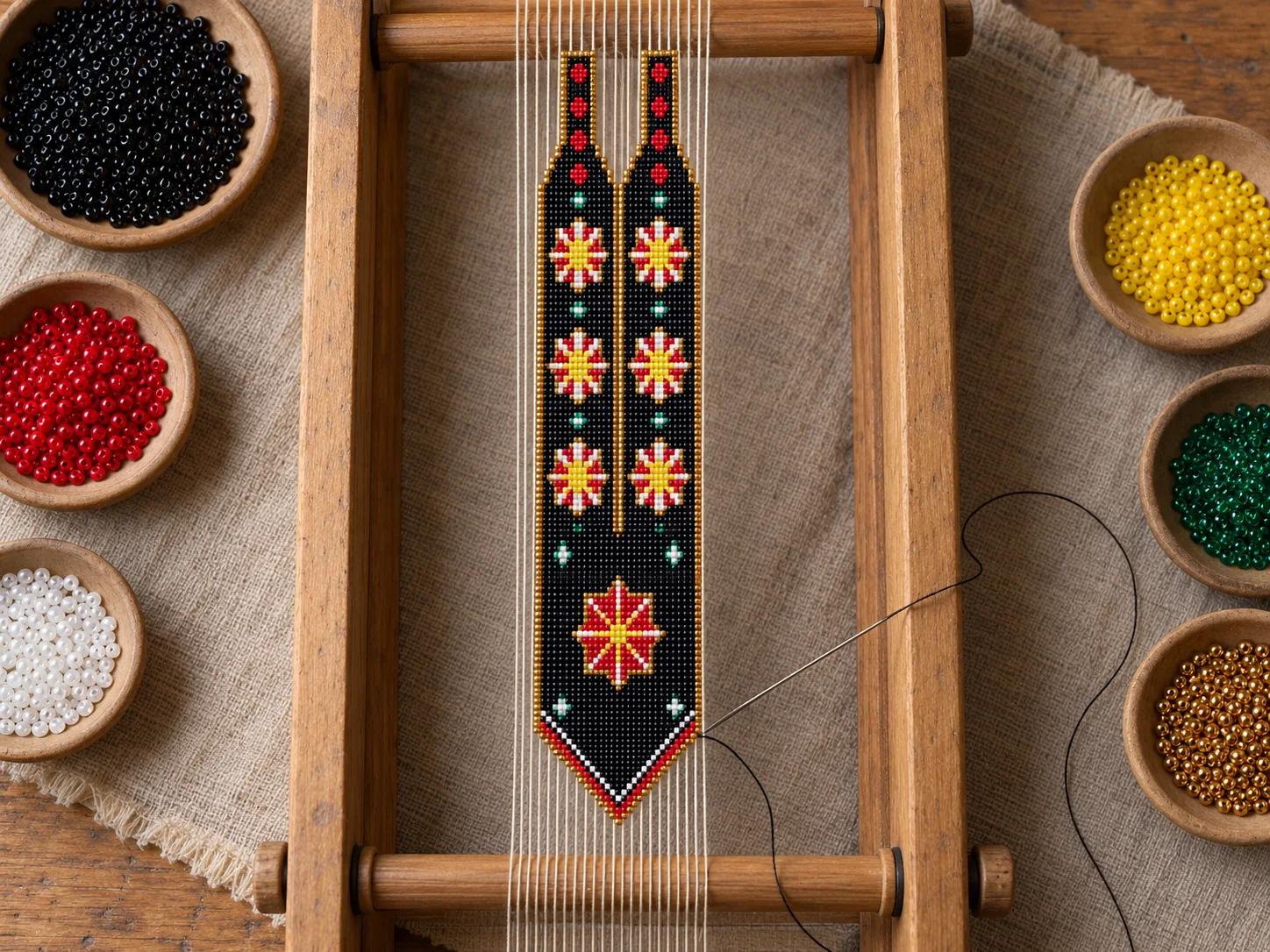
- 1Warp the loom with the panel width plus one threads, as long as one strap plus the panel, plus what your loom needs for tying on.
- 2Choose where to start and keep the chart the same way up throughout. Starting at the tip, the first row is a single bead and each row after it is two beads longer until the panel reaches full width.
- 3Weave the panel with one working thread, up to the join.
- 4From the join, give each half its own working thread. Weave them in turn, row by row, or finish one half and then the other; the split-loom tutorial above weaves the panel first, then one strap, then the other.
- 5Never carry a thread across the gap, or the halves stay tied together and can't open into a V.
- 6Finish by weaving the warp ends back into the work, then add ties or a clasp to the strap ends.
No loom? Square stitch builds the same straight grid by hand, so a gerdan chart works for it without changes.
How to make a gerdan pattern in Wevy
Wevy's gerdan grid is part of the Free plan and works in the browser and on phones. It starts at 58 × 170 beads, about 10 × 39 cm in Preciosa 10/0; resize it to the numbers from your plan. Cells take the shape of the bead you pick, so a circle you draw stays round once it is woven.
Colours come from real catalogues, Preciosa, Miyuki Delica, Miyuki Round and TOHO, by article number. The key gives each colour a letter and counts its beads and grams as you draw.
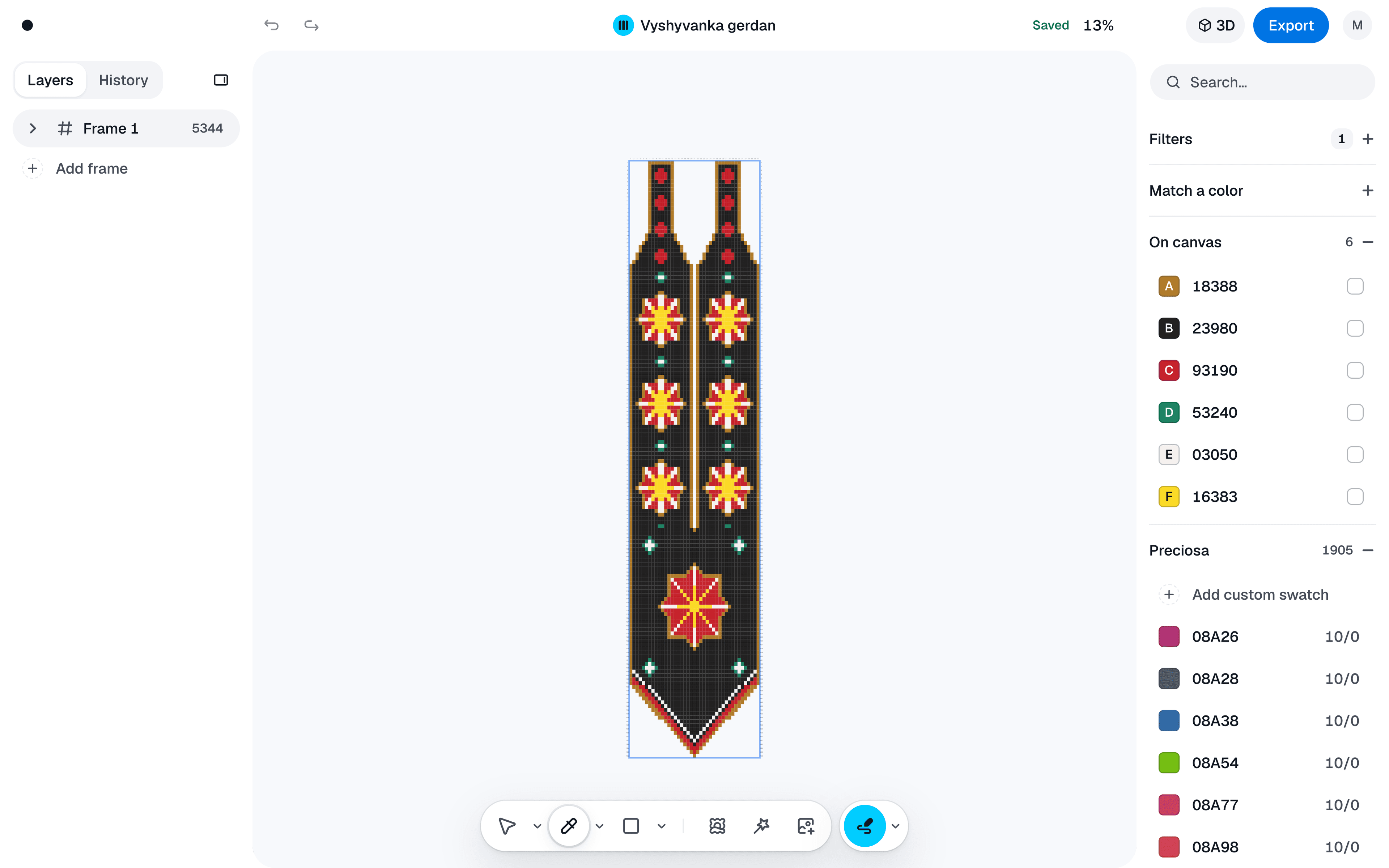
- 1Start a new file on the gerdan grid and choose your bead.
- 2Draw one half, then select it, copy it and mirror it across the gap.
- 3Draw the panel and the point around the centre column.
- 4Check the finished piece in the 3D preview, with the glass, matte or metallic finishes you picked.
- 5Export a PDF with the chart, letters and bead key, or weave from Make mode, which lights each row, keeps your place and can read the colours aloud.
Starting from a picture? The free image to bead pattern tool gives you a first draft without an account, and tracing a photo under the grid comes with Hobby and Pro.
Free gerdan patterns and where traditional charts come from
The Wevy marketplace has free gerdan patterns from makers, traditional and modern. Making a pattern from the marketplace in Make mode is free on every plan. Paid patterns are priced by their creator in UAH, USD or EUR; you contact the creator directly, and Wevy takes no commission.
Traditional charts come from museums and old pieces. In November 2025 the Ivano-Frankivsk Regional Museum of Local Lore showed 48 beaded ornaments from Pokuttia, the Hutsul region, Boykivshchyna and Opillia, and made the charts of its 12 oldest gerdans free in an electronic catalogue, Ukrinform reported.
- Museum catalogues: records with photos and measurements, like the State Catalogue of the Museum Fund of Ukraine.
- Books and maker charts: credit the author, and don't resell someone else's chart.
- Old photographs, like the ones behind Lesya Ukrainka's gerdan: chart the shapes, then choose the colours yourself.
To adapt a traditional chart, re-plan it in your beads first. A museum ribbon 2.5 cm wide is about 14 beads of Preciosa 10/0, 17 of Miyuki Round 11/0 or 19 of Delica 11/0, and the rows change just as much.
Common mistakes and fixes
| What you see | Why, and how to fix it |
|---|---|
| The halves won't open into a V | A working thread crossed the gap and tied them together. Weave each half with its own thread and leave the gap empty. |
| The point is lopsided | The panel has an even width, or the motif is off the centre column. Make the panel 2 × strap + 1 and centre odd-width motifs on the middle column. |
| Stars and circles come out tall | The motif was drawn on square paper. Loom beads are a third taller than wide; draw on a grid in your bead's proportions. |
| It won't go over the head | The straps are shorter than about 33 cm each. Lengthen them, or add ties or a clasp. |
| One colour ran out | The count was for the whole piece, not per colour. Add 10 to 15 percent to each colour and buy one batch. |
| A motif is cut off near the neck | The repeat doesn't fit the strap. Plan repeats from the join up and let the leftover rows fall at the neck end. |
Questions beginners ask
What is a gerdan?
A gerdan is a Ukrainian beaded neck ornament from the Carpathian region, added to Ukraine's National List of Intangible Cultural Heritage in 2023. Today the word usually means a loom-woven band, often two straps that meet at a panel or medallion on the chest.
How do I make my own gerdan pattern?
Plan the size first: the strap width and length, then a panel 2 × strap width + 1 beads wide. Draw one half on a grid in your bead's proportions, mirror it across the one-bead gap, centre the panel motif on the middle column, and count the beads per colour.
What gerdan should a beginner make first?
A narrow one: 7-bead straps 25 cm long and a 15-bead panel 7 cm tall. In Preciosa 10/0 that is about 1,935 beads, or 21 g, on 16 warp threads. Use two or three colours and a geometric motif.
How long should a gerdan be?
Measure from the back of the neck down to where the panel should start. To slip over the head without a clasp, each strap needs about 33 cm; with ties or a clasp it can be shorter. The panel hangs below that and adds its own height, for example 10 cm.
How many beads do I need for a gerdan?
Each strap takes its width × its rows, and the panel its width × its rows minus the corners cut by the point. A gerdan with 10-bead straps 30 cm long and a 21-bead panel 10 cm tall takes about 3,434 beads of Preciosa 10/0, or 38 g. Add 10 to 15 percent per colour.
How many warp threads does a gerdan need?
One more than the panel width: 22 for a 21-bead panel, 42 for a 41-bead panel. The two halves share them, and the gap is one empty space between the middle warps.
What is Lesya Ukrainka's gerdan?
A narrow beaded band worn close to the neck, copied by makers from photographs of the poet in Ukrainian dress. The photos are black and white, so the colours of modern charts are a reconstruction; in her time such a choker was called a sylianka.
Where can I find free gerdan patterns?
The Wevy marketplace has free gerdan patterns from makers, and making them in Make mode is free on every plan. For traditional charts, look at museum catalogues: in 2025 the Ivano-Frankivsk Regional Museum of Local Lore published the charts of its 12 oldest gerdans.