What you need
- Cylinder beads such as Miyuki Delica 11/0, or even round seed beads
- Beading thread and a size 10 or 12 needle
- A stop bead in a contrasting colour
- The chart with its colour key
Words the chart uses
- Column
- One pass of the needle up or down the chart. On the chart a column zig-zags, because every other bead is shifted by half a bead.
- Up bead
- A bead that sticks out of the last column. The needle passes through up beads only, and each new bead sits in the gap between two of them.
- Stop bead
- A spare bead tied at the start so the first beads don't slide off. It is not part of the design.
- Run
- A count and a letter, like "2 A", in a word chart. It is still stitched one bead at a time.
Stitch columns 1 to 5
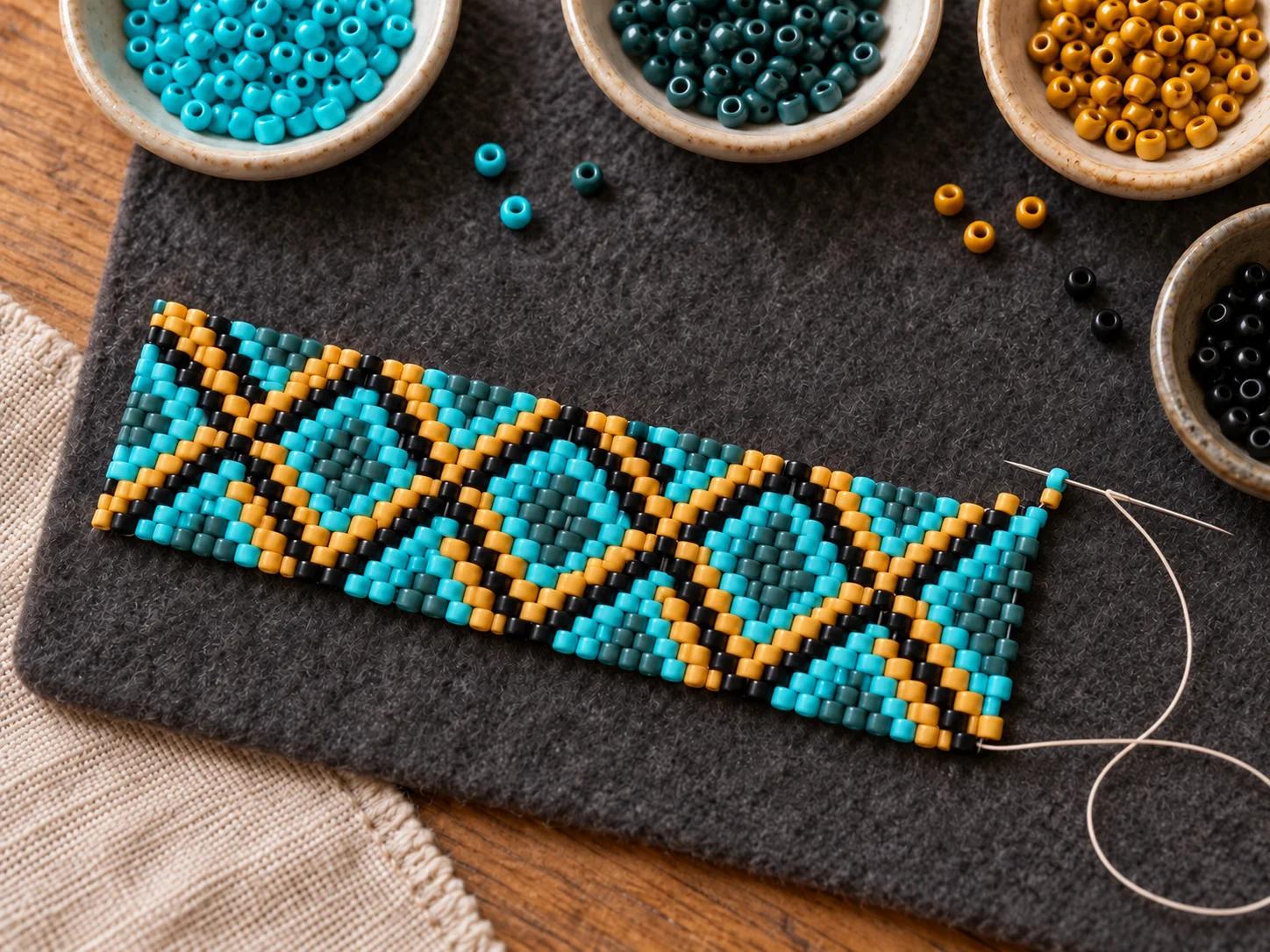
A 15-bead sample in three Preciosa colours, laid out the way Wevy draws a peyote chart. Make mode follows the same order, one bead at a time, and reads each letter aloud.
Where to start on a peyote chart
Find column 1, the left edge of the chart. String columns 1 and 2 as one line, reading the zig-zag from the bottom bead up. They only separate into two columns once column 3 is stitched in.
The work is not turned between columns: the needle goes down one column and up the next. In Wevy, Make can also start from the right-hand edge if that suits your hand better.
How to read a peyote word chart
A word chart lists the pickups as text, for example "Column 3 (↓): B, C, C". A run such as "2 A" is two stitches, not one loop of two beads: pick up one bead, stitch it, then the next.
Many published peyote charts are drawn sideways, in rows: rows 1 and 2 strung together, then row 3. It is the same stitch turned a quarter. Read "row" where this guide says "column".
Even or odd count?
The sample has six beads in the first zig-zag, an even count. Every column then ends by passing through an edge bead, so the turn is the same at the top and the bottom.
With an odd count, one edge has no bead to pass through and the last bead needs a special turn. Follow the pattern author's instructions for that edge. Tubular and circular peyote also start differently.
Common mistakes and fixes
| What you see | Why, and how to fix it |
|---|---|
| The edge grows wider | A bead was added at the turn instead of stitched in. Every new bead passes through an up bead. |
| A loose loop of beads | A run was picked up all at once. Stitch each bead of a run separately. |
| The colours shift by one | The needle went through a down bead. Only up beads take the needle. |
| The design comes out mirrored | The first zig-zag was strung from the top. Columns 1 and 2 are read from the bottom bead up. |
Questions beginners ask
Why are columns 1 and 2 strung together?
They go on the thread as one zig-zag line. Column 3 pulls them apart into two columns.
Is mosaic the same as peyote?
Yes. Mosaic weaving (мозаїчне плетіння) is the Ukrainian name for peyote stitch.
Does "2 A" mean picking up two beads at once?
No. It means two A stitches, one bead each.