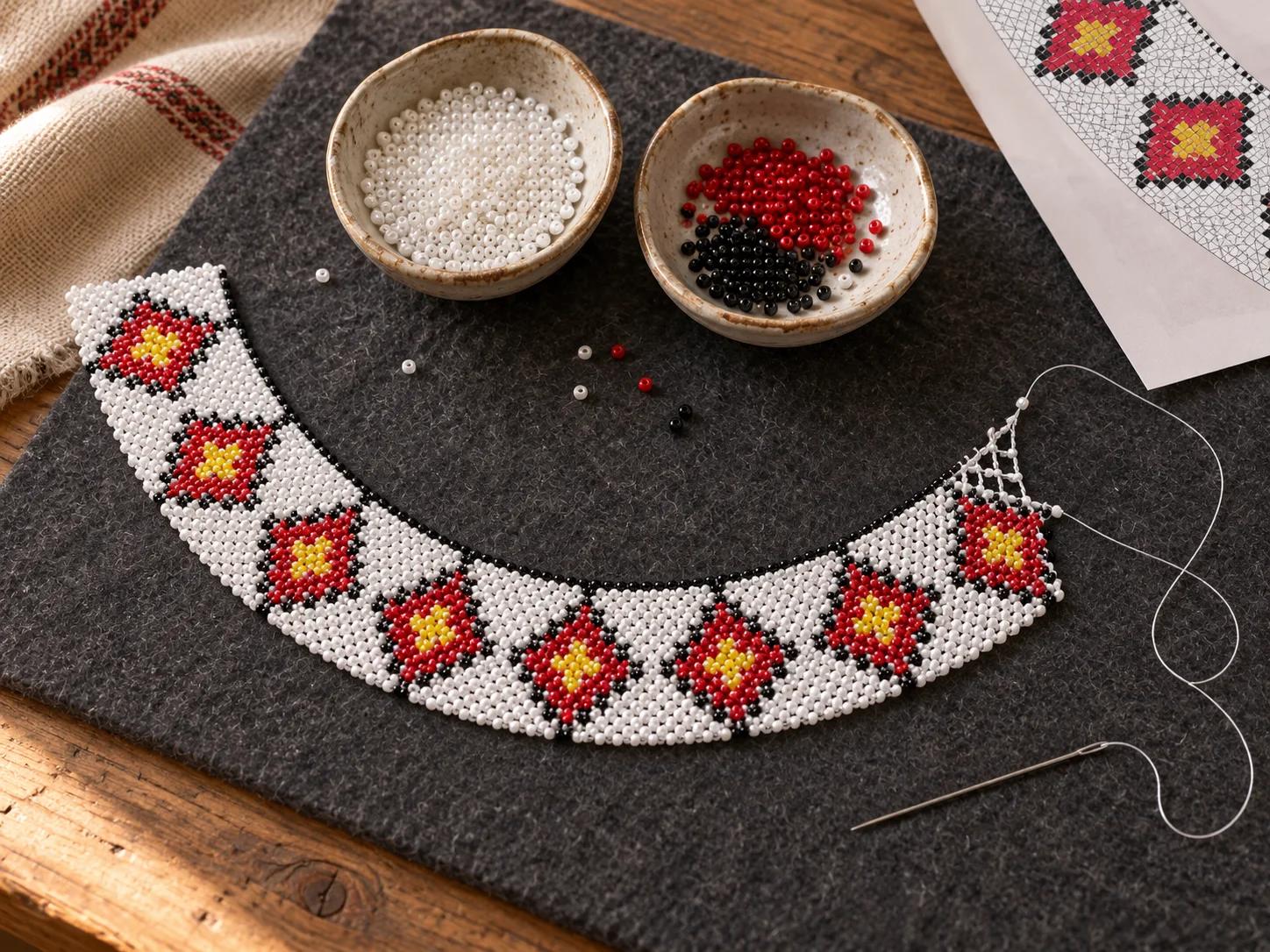
What you need
- Round seed beads 10/0 in two or three colours
- Strong beading thread that passes several times through one bead
- One beading needle
- A bead mat and the chart with its colour key
Words the chart uses
- Strand
- One pass of the thread across the collar, from the neck edge to the lower edge or back. Each strand adds one column of diamonds.
- Group
- The new beads you pick up between two pass-throughs. In this example a group is five: two side beads, a middle bead and two more.
- Shared bead
- The middle bead of a group. The next strand passes through it, so it becomes the corner of two diamonds.
- Repeat
- The part of the ornament that appears again along the necklace. Count it once, then repeat it.
Weave your first two strands
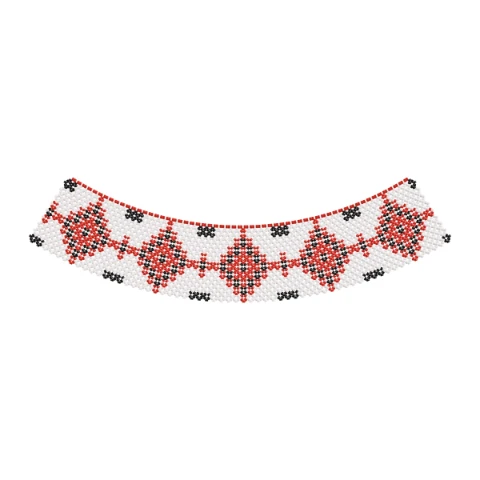
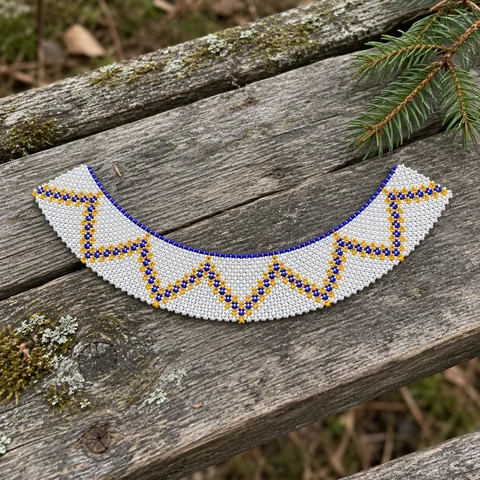
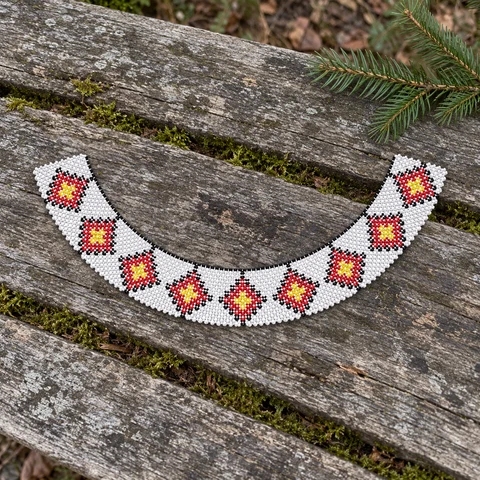
This practice net has two beads on every diamond side, in Preciosa 10/0 colours. It follows classic one-needle netting: pick up five, skip five, pass through the sixth.
How to start a sylianka from the chart
Find the start marker and the first strand. In one-needle netting the first strand is strung in one go: it is the edge of the necklace at the clasp end. Pattern authors usually write it as a list of counts, for example 11 red, 2 white, 1 red.
Then read every following strand as groups. A group ends where the needle passes through a bead that is already in the work. Count only the new beads: the bead you pass through was counted in an earlier strand.
How strands join into a mesh
The strands run across the collar, from the neck edge to the lower edge, and the necklace grows in length one strand at a time. The direction alternates: one strand up, the next one down.
Where the group size changes, the net changes shape. Small groups near the neck keep it tight; larger groups lower down let it spread into a collar. Follow the counts on the chart exactly, because they shape the necklace.
One needle or two?
Some sylianka patterns are woven with two needles, one on each end of the thread: each needle picks up one side of a diamond and both cross through one bead at the bottom. The chart can look the same; the route of the thread is different. Follow the method the pattern author names.
Wevy's Make mode walks a sylianka diamond by diamond by default. In Order mode a pattern author can set any route bead by bead, including one-needle strands, and Make follows it.
Common mistakes and fixes
| What you see | Why, and how to fix it |
|---|---|
| The net puckers | A group has the wrong count. Count the new beads against the chart before you pass through. |
| The diamonds grow too wide | A shared bead was picked up again as a new one. Pass through the middle bead that is already in the work. |
| The needle comes out in the wrong place | You skipped the wrong number of beads. Skip as many as the group you just picked up, then pass through the next one. |
| The ornament has shifted | You lost your place in the repeat. Go back to the last complete repeat and count from there. |
Questions beginners ask
Do I need a loom to make a sylianka?
No. A sylianka is woven by hand with a needle. A gerdan can be woven on a loom; a sylianka net cannot.
Is a sylianka woven with one needle or two?
Both exist. One needle is the most common: the net is built strand by strand, passing through the middle bead of each earlier group. Use the method your pattern describes.
What beads are best for a first sylianka?
Round Czech seed beads 10/0, such as Preciosa, in two or three high-contrast colours. Even beads keep every diamond the same size.
Can I follow a sylianka pattern in Wevy for free?
Yes. Make-only patterns open in Make mode on every plan, including Free. Designing your own sylianka grid needs Hobby or Pro.