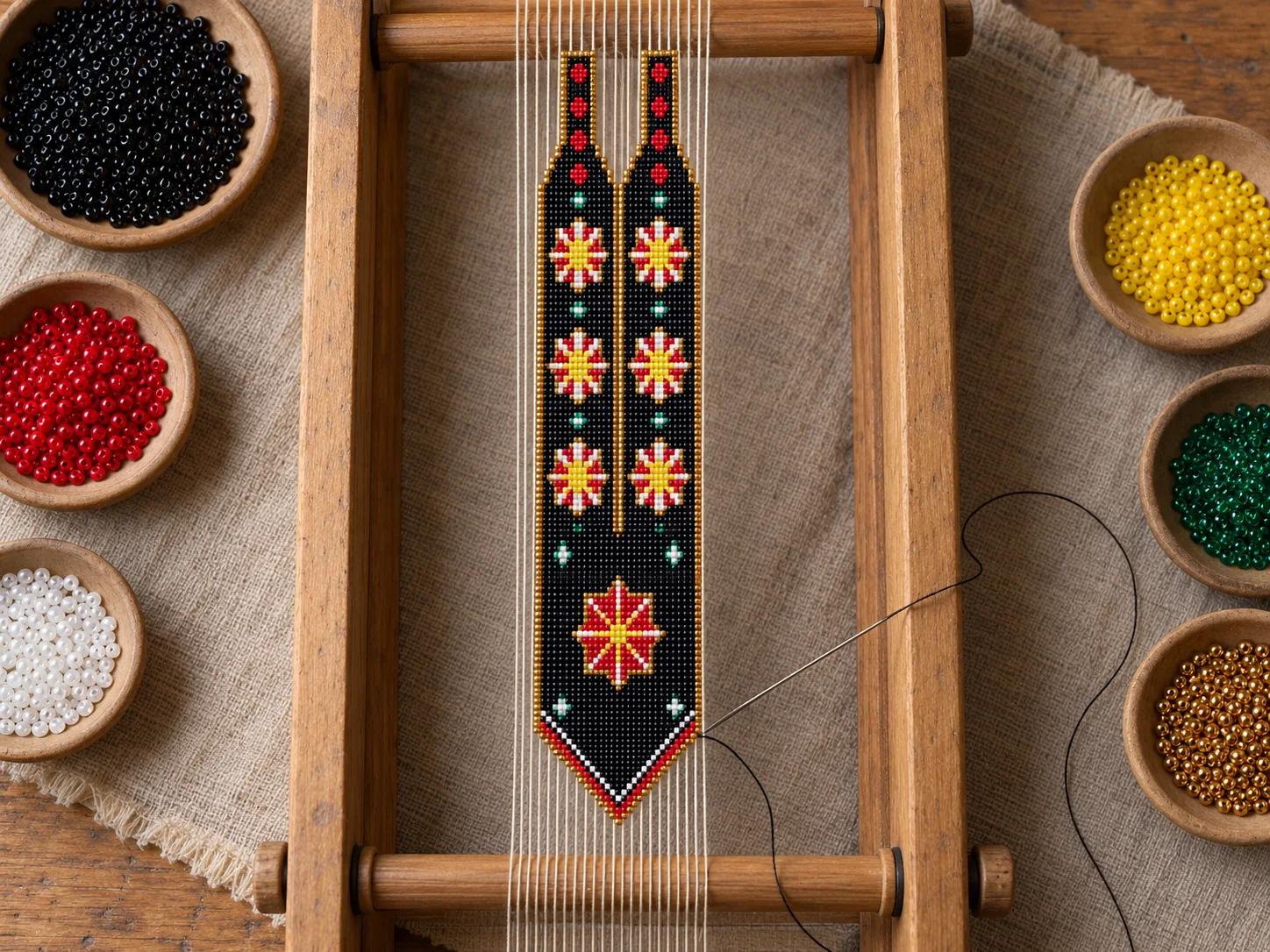
What you need
- A bead loom with spring or comb separators
- Cylinder or round seed beads 10/0 or 11/0
- Strong beading thread for the warp and the working thread
- A long beading needle and the chart
Words the chart uses
- Warp
- The lengthwise threads stretched on the loom. You need one more warp thread than beads across.
- Working thread
- The thread on the needle, also called the weft. It carries each row of beads across the warp.
- Return pass
- The second trip through the same row, above the warp. It locks the row; it is not a new row.
- Row 1
- The first row you weave. Check where the chart marks it: at the top or at the bottom.
Weave your first four rows
The chart is four beads wide, so the loom needs five warp threads. Each step lights the row in hand, the way Make mode does in Wevy.
How many warp threads do you need?
Count the beads across the widest row of the chart and add one. A 4-bead strip needs 5 warp threads; a 21-bead gerdan panel needs 22. Leave enough length at both ends for finishing; your loom's manual shows how to tie on.
Keep the tension even. A loose warp thread lets its beads sag, and the strip curves.
How to read a loom pattern row by row
A loom chart is a grid where each cell is one bead and each letter points to the colour key. Find row 1, read it in the direction you pick up, and keep the chart the same way up for the whole piece.
In this method every row reads in the same direction, because the working thread always ends back on the side it started from. Mark each finished row, or let Wevy's Make mode keep your place and read the colours aloud.
From a strip to a gerdan
A gerdan is the same weave, planned bigger: two straps that join into a wider panel, often ending in a point. Weave a short strip first to settle your tension, then follow a full gerdan chart.
Wevy's bead pattern size calculator shows how long and wide a chart will be in your beads before you warp the loom.
Common mistakes and fixes
| What you see | Why, and how to fix it |
|---|---|
| The edges pull inward | The working thread is too tight. Pull each return pass only until the row lies flat. |
| A bead sits on top of a warp | It missed its gap. Push it back between the threads before the return pass. |
| A row slips loose | The return pass went under the warp instead of above it. Redo it above the threads. |
| The pattern comes out mirrored | The row was read from the wrong side. Keep the chart and the loom facing the same way. |
Questions beginners ask
How many warp threads do I need on a bead loom?
One more than the number of beads across: 4 beads need 5 threads, 10 beads need 11.
Does the return pass count as a row?
No. It goes back through the same beads to lock them. Pick up a new row only after it.
Can I make a gerdan without a loom?
Yes. Square stitch gives the same straight grid by hand. The loom is faster for long, even bands.