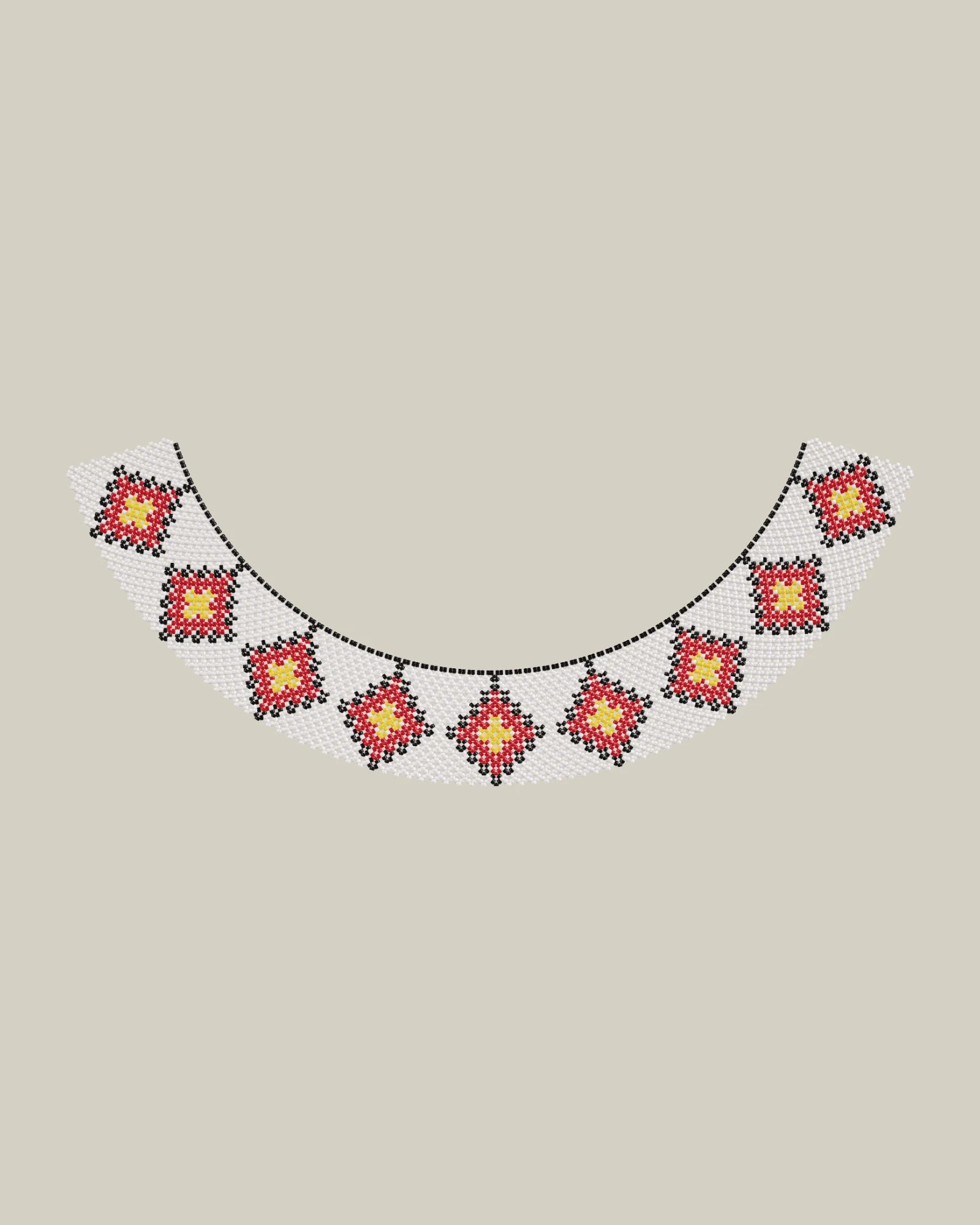
What you need
- The finished length and width you want
- Two to four bead colours in round 10/0
- Squared paper with a diamond grid, or a sylianka editor
- A traditional sylianka to study, from a museum or a book
Words the chart uses
- Strand
- One pass of the thread across the collar. The number of strands sets the necklace's length.
- Group
- The beads between two shared beads. Its size sets how open the net is.
- Shared bead
- The bead at a diamond's corner, passed through by two strands.
- Repeat
- The part of the motif that appears again along the necklace.
Plan the net: width, length and group size
Start with the collar, not the motif. Decide how deep it is from the neck edge to the lower edge, in diamonds, and how long it is, in strands. A first piece of 10 to 15 strands around a short repeat takes a few evenings.
Then choose the group size. Small groups make a tight, firm collar; bigger groups open the net into a lacy one. Many traditional sylianky grow their groups towards the lower edge, which is what makes the collar fan out.
Draw the motif on the diamond grid
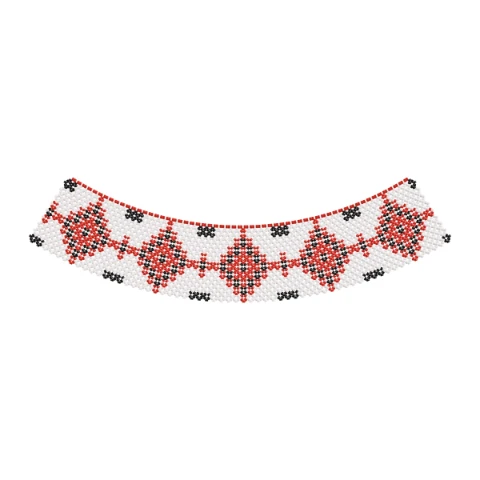
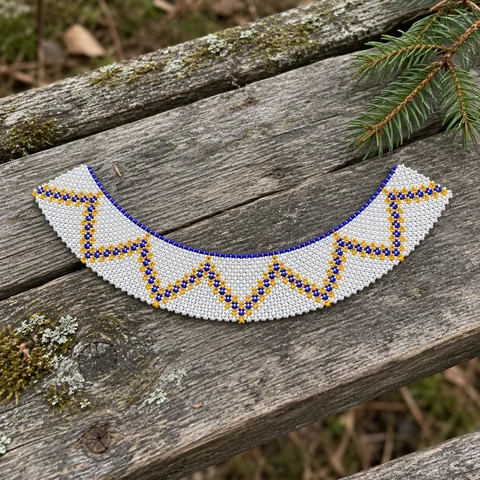
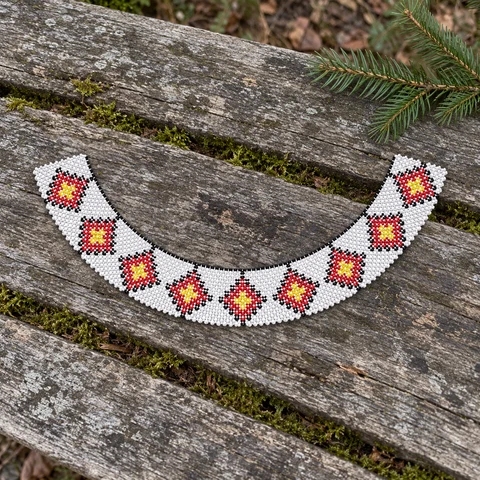
Colour whole diamonds, or the shared beads at their corners, rather than single beads in the middle of a side. Classic sylianka motifs are built that way: rhombuses, zigzags, crosses and stepped stars that read clearly from a distance.
Draw one repeat and check that it joins cleanly to the next. A motif that is symmetrical around the centre strand keeps the necklace balanced at both ends of the clasp.
- 1Fill the background diamonds with the main colour.
- 2Draw the outline of one motif in the contrast colour.
- 3Fill the motif and check the shared beads at its corners.
- 4Repeat it along the collar and mirror it at the centre.
Choose colours that read in a net
A sylianka is mostly holes, so colours look lighter and weaker than on a solid piece. Pick a background and one strong contrast first; white with red, black or blue are traditional because they stay readable.
Add a third colour only for an accent: the motif's centre or the lower edge. Check that the beads are the same brand and size, so the net stays even.
Check it in 3D, then weave
Flat, the net looks wider than it will on the neck. In Wevy the sylianka editor draws on the real diamond grid and shows the necklace in 3D, so you can see the curve and the motif together before you string a bead.
When it looks right, Make mode walks the pattern diamond by diamond and remembers your place. Designing your own sylianka grid in Wevy needs the Hobby or Pro plan; following any sylianka pattern in Make mode is free.
Common mistakes and fixes
| What you see | Why, and how to fix it |
|---|---|
| The motif looks broken | Single beads were coloured mid-side. Colour whole diamonds or their corner beads. |
| The collar does not curve | Every group is the same size. Let the groups grow towards the lower edge. |
| Colours disappear | Too little contrast for an open net. Use one dark and one light colour as the base. |
| The two ends don't match | The motif isn't centred. Mirror it around the middle strand. |
Questions beginners ask
How wide should a first sylianka be?
Three or four diamonds deep and 10 to 15 strands long is a good first piece: big enough to show a motif, small enough to finish in a few evenings.
Which beads are best for a sylianka?
Round 10/0 seed beads; Czech Preciosa is the traditional choice. Round beads sit well in the curve of the net; cylinder beads make it stiff.
Can I design a sylianka on squared paper?
Yes, if you draw the diamond grid on it first. An editor that draws on the real net saves the conversion and shows the result in 3D.
Do I need a paid plan to design a sylianka in Wevy?
Designing a sylianka grid needs the Hobby or Pro plan. Following any sylianka pattern in Make mode is free on every plan.